
Finding the right person when you need to hire solidworks designer talent is not as simple as browsing freelancer profiles and picking the lowest quote. SolidWorks is a specialized parametric modeling platform used by automotive suppliers, medical device firms, and consumer product teams worldwide. The person you choose needs to understand not just the software menus but the manufacturing process your part will undergo after the model is complete. Here is how to find, vet, and hire the right professional without wasting time or budget on the wrong fit.
Where to Hire SolidWorks Designer Talent Online
Three channels consistently produce reliable candidates. Freelance platforms like Fiverr and Upwork let you filter by specific CAD skills, completed project count, and delivery speed. Engineering-specific communities like GrabCAD model library have job boards where experienced SolidWorks designers post their availability with portfolio links and specialization details. Direct studio websites like minicad.io offer dedicated engineering teams with verified track records, structured revision processes, and zero platform commission overhead — so more of your project budget goes toward actual design work rather than marketplace fees.
When you find solidworks freelancer candidates, prioritize those with at least 100 completed orders and verified client reviews. High volume proves the designer can handle real production demands — tight deadlines, ambiguous client briefs, multiple revision rounds, and manufacturing feedback loops. A designer with 4,470 or more verified reviews and a rating of 4.9 out of 5 has been market-tested through thousands of real projects in ways that no portfolio review or interview question can replicate.

What to Look for in a SolidWorks Portfolio
A strong portfolio shows SolidWorks feature trees alongside finished renders, not just beauty shots of completed models. Ask for a screenshot of the feature manager panel for a complex part. A clean, well-organized tree with logically named features like Boss-Handle, Cut-USB-Port, and Fillet-Edge-R3 indicates disciplined parametric modeling habits and proper design intent documentation. A tree full of unnamed features, suppressed errors, imported bodies, and direct-edit operations signals modeling practices that make future modifications difficult, expensive, or impossible.
Look for deliverable diversity — parts, multi-component assemblies, sheet metal fabrication models, and dimensioned technical drawings with GD&T callouts all represented in the same portfolio. A solidworks designer for hire who handles all four deliverable categories competently saves you from coordinating multiple freelancers on a single project, which reduces communication overhead, eliminates file compatibility issues, and keeps the entire project under one quality standard.
Pricing When You Hire a SolidWorks Designer
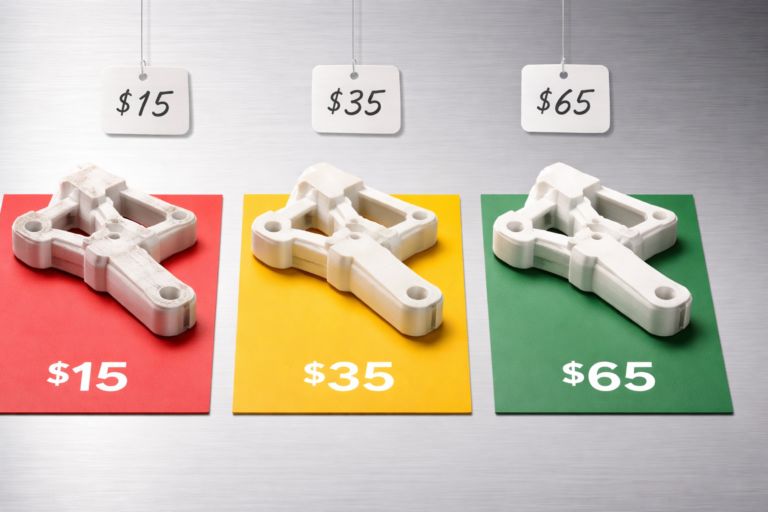
Hourly rates range from $25 to $100 or more depending on the designer’s geographic location and industry specialization. US and Western European designers typically charge $50 to $100 per hour. Equally skilled designers operating from Egypt, India, or Eastern Europe charge $25 to $50 for equivalent output quality and comparable turnaround times. Fixed-price packages work well for clearly defined scopes — a single part with a 2D technical drawing runs $79 to $149, while multi-part assemblies with renders range from $120 to $500 or higher depending on component count, geometric complexity, and required documentation depth.
Never select a remote solidworks expert based solely on price. A designer charging $25 per hour who takes 10 hours to deliver a mediocre result costs more than a $50 per hour professional who finishes in 3 hours with cleaner geometry, better manufacturing awareness, and fewer revision rounds needed. Always request an estimated timeline alongside the hourly rate — total project cost and delivered quality matter far more than the per-hour number printed on a quote.
Red Flags When You Hire SolidWorks Designer Candidates
Avoid designers who deliver only STL mesh files without native SolidWorks sources. You need SLDPRT and SLDASM files to make any future modifications without rebuilding the model from scratch. Avoid anyone who provides a firm quote without asking a single clarifying question about your requirements, your target manufacturing process, or your assembly constraints — they are either overconfident or planning to make critical assumptions you never authorized. And avoid designers with beautiful photorealistic renders but zero technical drawings in their portfolio. Renders demonstrate visualization and marketing skill. Dimensioned engineering drawings with GD&T tolerance callouts prove actual manufacturing competence — the skill that determines whether your part can be physically produced.
Another critical red flag is a designer who uses only mesh-based modeling tools like Blender or ZBrush for mechanical parts. These tools excel at organic sculpting and animation but cannot produce the precise, dimensionally controlled parametric geometry that manufacturing processes require. If you need functional mechanical parts, verify the designer works natively in SolidWorks, not a visualization tool marketed for a different purpose entirely. The difference becomes obvious the first time you need to change a hole position by 2 mm — parametric models update in seconds while mesh models require manual reconstruction of the affected geometry.
Setting Up Communication for Success
Define four items before any work begins: the number of included revision rounds (two to three is the industry standard), expected response time for questions, file delivery format list, and preferred communication channel. WhatsApp and email both work well for international engineering projects. Share all design feedback using annotated screenshots with clear markups — a red circle on the model with a concise note like “increase this fillet to R3” communicates faster and more accurately than three paragraphs of written text attempting to describe the same feature location verbally. Establish a feedback cadence early — a daily 15-minute check-in over WhatsApp works well for projects spanning multiple days, while single-day jobs typically need only a delivery review and one focused revision exchange.
Explore real examples of this work in our portfolio — see our custom brackets and mounts in SolidWorks and custom PCB enclosure project box projects. Need professional engineering support? Our SolidWorks modeling service and STL file design service deliver production-ready files.
One question that tells you who understands manufacturing
Ask: “I am printing this on an FDM printer with a 0.4 mm nozzle; how thick do the walls need to be, and how much clearance for a sliding lid?” The right answer is about 1.2 mm walls and 0.3 mm of clearance per side, with a question back about the material. A designer who has to look it up has not shipped printed parts.
Three red flags
A refusal to sign an NDA. A quote under $15 for a part model: either the work is a template or the revisions will be charged. Contact only through a marketplace inbox with no portfolio site, no reviews outside the platform and no name you can check.
Managing the project once you have hired
Collect feedback into one numbered list per revision round instead of a stream of messages; each list is one round. Answer the designer’s questions promptly, because every open question stops the model. Approve the shape on a render before asking for print files.
Why a Professional Studio Beats Random Freelancers
A solo freelancer can vanish mid-project with no accountability and no backup plan.
Ready to turn your idea into a 3D CAD model? MiniCAD has delivered 7,000+ orders over 9+ years, rated 4.9 out of 5 across 4,470+ Fiverr reviews.
Packages start at $79. Send your sketch, photo or sample through our quote form and get a personal quote within 24 hours. You pay only after you accept it. Questions? Email contact@minicad.io.