Most Amazon sellers launch a product without understanding what amazon fba product development actually requires. They sketch an idea, get a quote from a factory, and assume the CAD work happens somewhere in the middle. That assumption costs them months of delays, failed prototypes, and products that arrive with dimensions nobody measured twice. The development pipeline is a structured sequence of five stages, each building on the last — and sellers who move through it deliberately reach launch faster than those who improvise.
What Amazon FBA Product Development Actually Involves
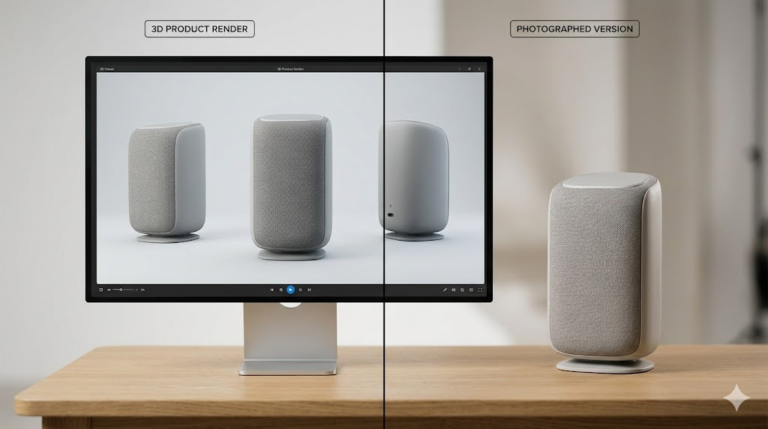
Amazon FBA product development is not a single service — it is a pipeline. Concept validation, CAD modeling, physical prototyping, manufacturing file preparation, and design freeze each produce a tangible output. Skip one, and the next stage builds on a faulty foundation. The factories you eventually hire expect geometry files, not ideas. The 3D printers you use for validation expect STL files, not sketches. Understanding the full pipeline before you start is what separates sellers who hit launch dates from those who miss them by a quarter.
Stage 1: Idea Validation and Getting Your Sketch Right
Before a single CAD file is opened, the idea has to be precise enough to model. That means dimensions — not approximate, but actual. What is the overall envelope? 80mm × 40mm × 20mm is a model; “about the size of a deck of cards” is a starting point for confusion. Annotated sketches — even hand-drawn ones on paper, photographed and emailed — are the most useful input a seller can send an engineer. Include critical dimensions (the ones that cannot change), note any moving parts, and flag surfaces that need a smooth finish or tight tolerance. One hour spent on a precise sketch saves three rounds of CAD revisions later.
Stage 2: CAD Modeling — Where Physical Specifications Are Locked
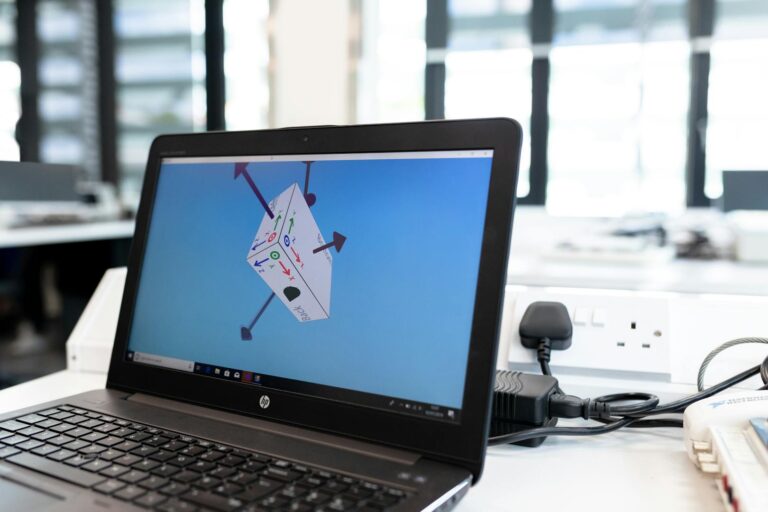
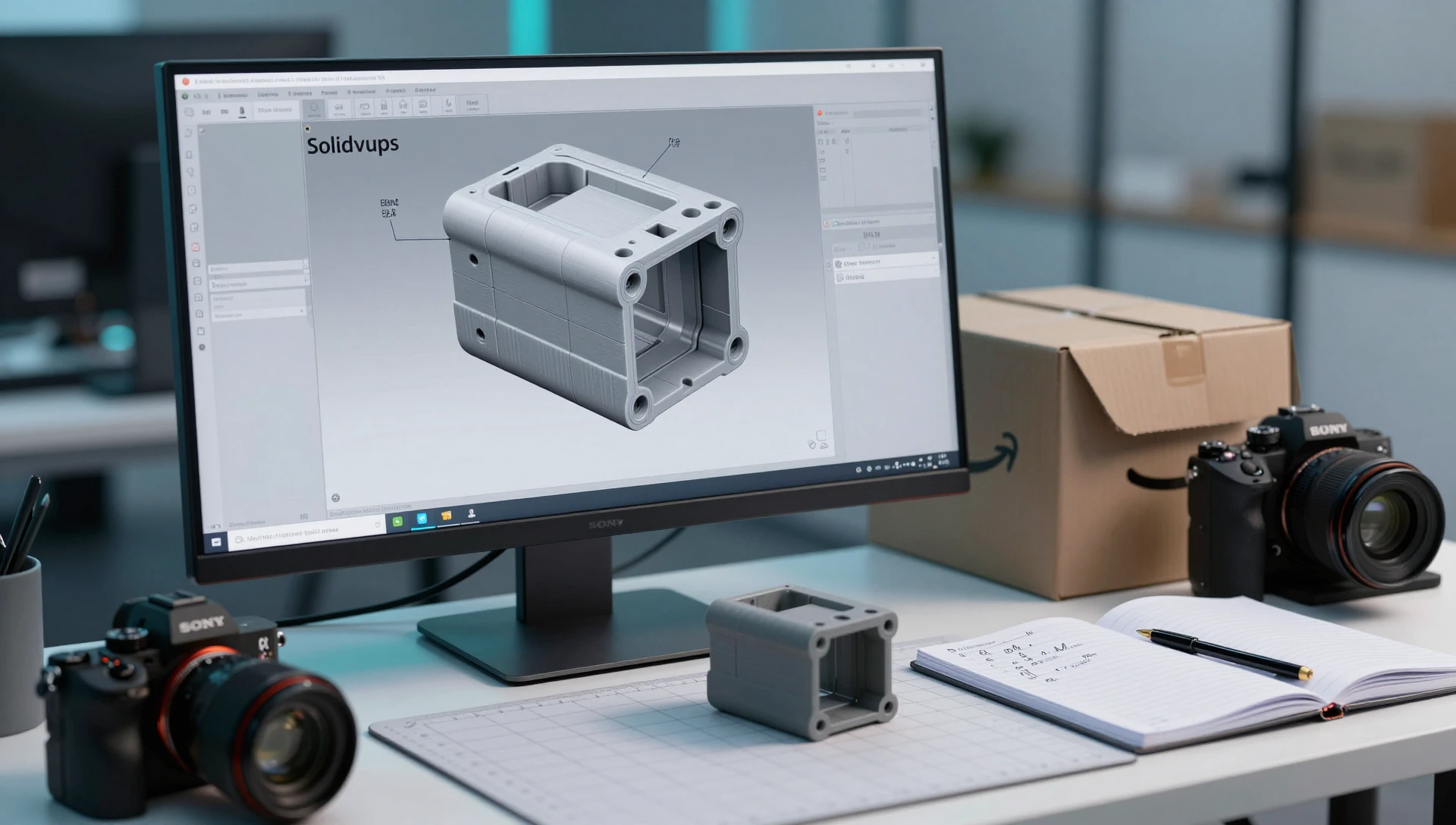
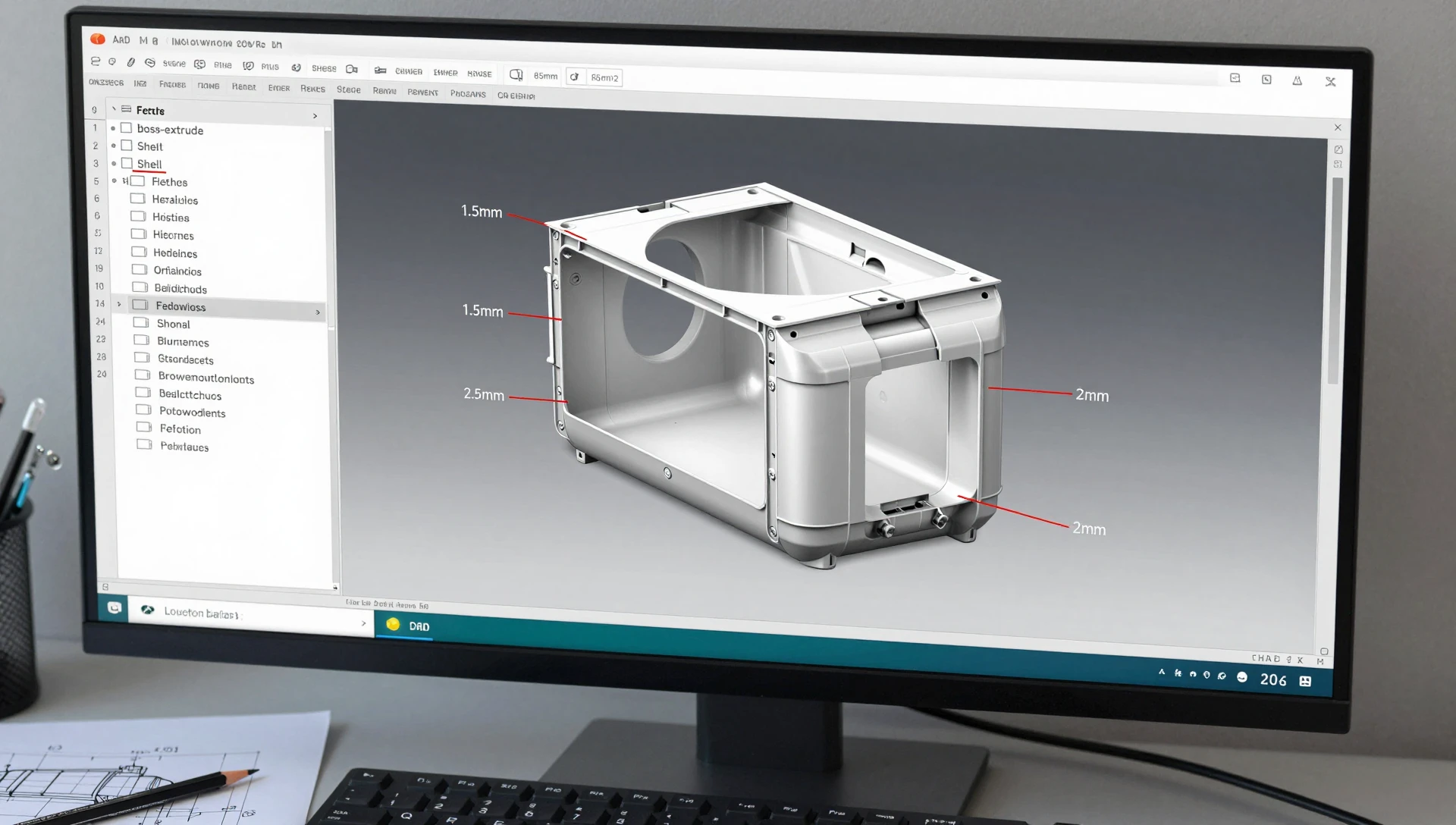
This is where the product stops being an idea and becomes a manufacturable object. A SolidWorks model captures every dimension, tolerance, wall thickness, and geometric relationship in a parametric format that a supplier can measure, quote, and produce from. The output at this stage is a STEP file for the manufacturer and an STL or 3MF file for 3D-printed prototypes.
Two numbers matter here more than any others: wall thickness and draft angles. For injection-molded parts — the manufacturing method behind most Amazon consumer products — minimum wall thickness is 1.5mm, with 2–3mm preferred for structural walls. Draft angles of at least 1°, ideally 3°, are needed on vertical faces so the part releases cleanly from the mold. Missing either means a factory rejection, not just a design note. Models built in SolidWorks with these constraints baked in from the start do not get sent back. Parametric modeling makes late-stage constraint changes fast instead of catastrophic.
Stage 3: Amazon FBA Prototype Testing with 3D Printing
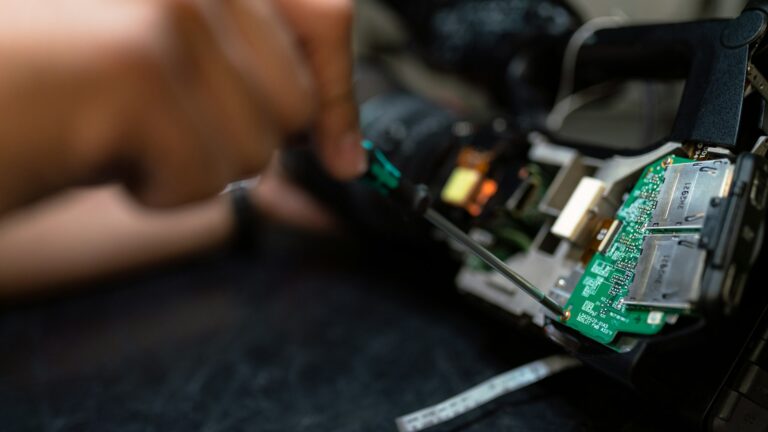
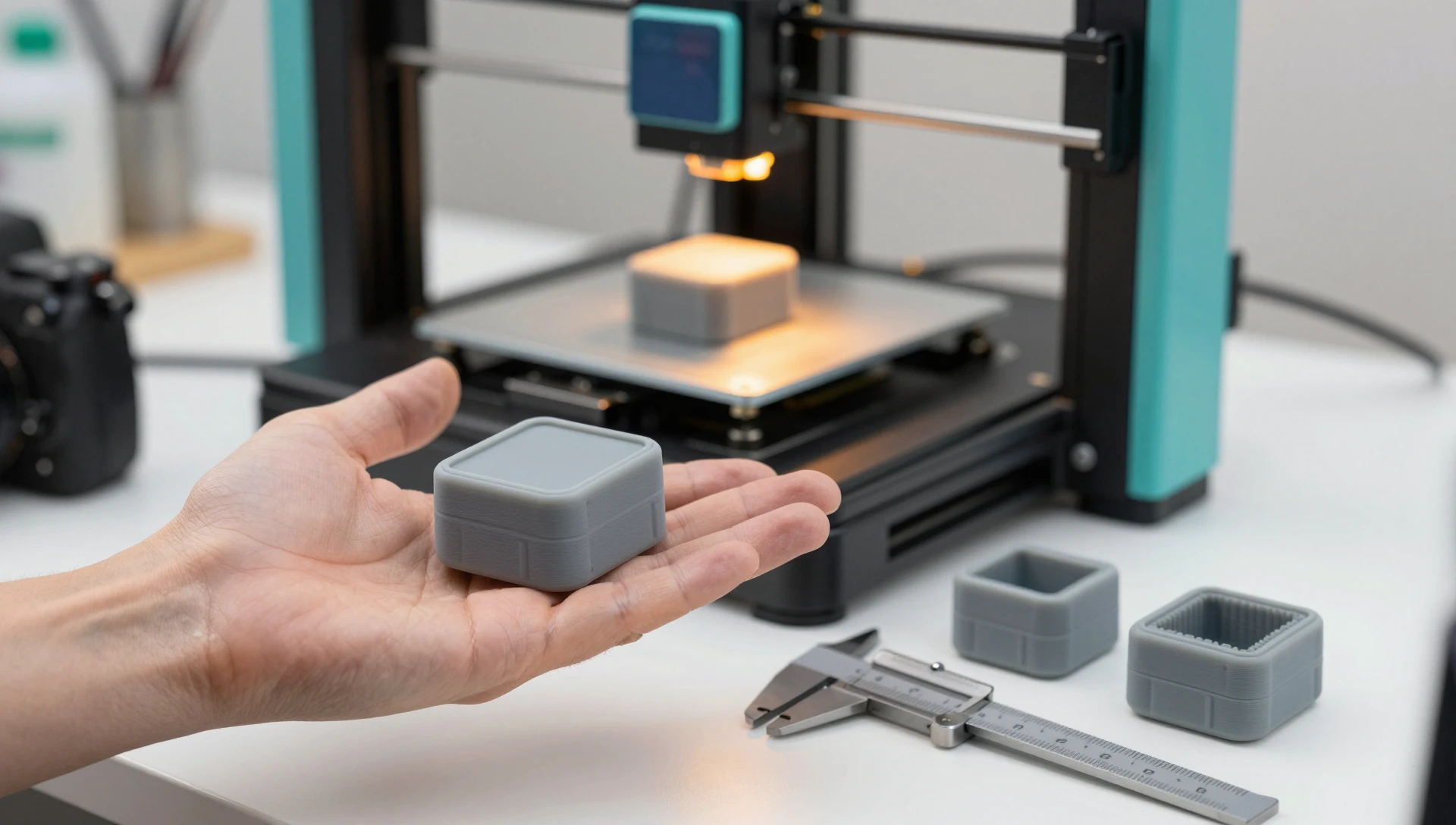
The amazon fba prototype stage is where assumptions meet reality. A 3D-printed version of the model — FDM for structural checks, resin for fine detail — answers questions no CAD file can: Does it fit the packaging envelope? Does the lid snap closed? Does the grip feel right in a human hand? FDM printing costs $2–20 per part at typical Amazon product sizes; resin runs $5–50 depending on volume and resolution. These are cheap experiments. The expensive version is discovering a tolerance error at the injection-mold tooling stage, where corrections cost $800–3,000 and add four to eight weeks of lead time.
Most products need two to three prototype iterations before the geometry is stable. The first reveals fit-and-function problems. The second confirms the fixes. The third — if needed — is a pre-production sample in the final material and color. Sellers who compress this stage to save two weeks typically extend the total timeline by eight. MiniCAD’s prototype design service covers the full iteration loop — from initial SolidWorks model through dimensionally verified, print-ready files for each round.
Stage 4: Manufacturing File Package for Your Supplier
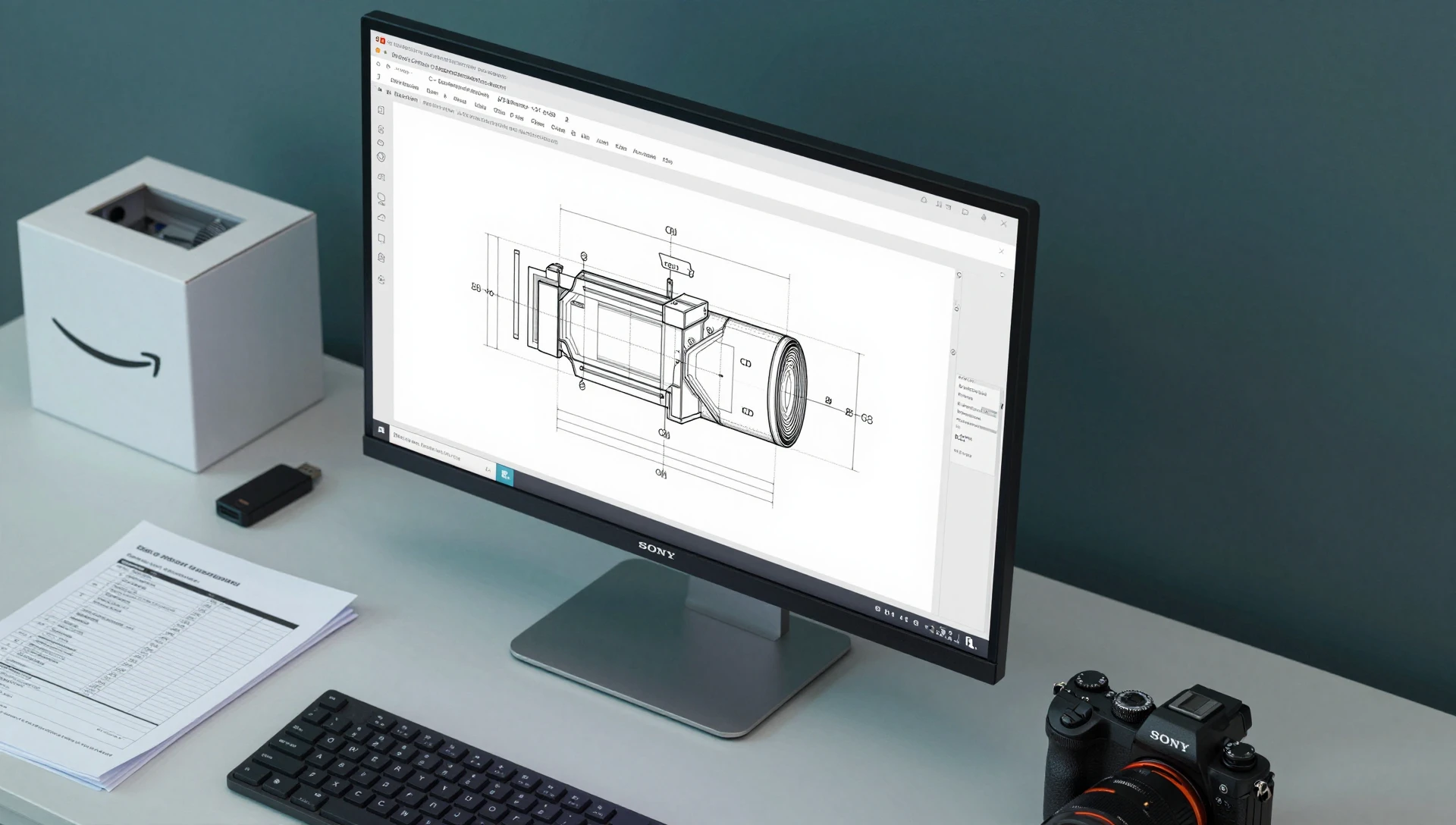
Factories do not work from STL files. A proper fba product development process ends with a complete manufacturing file package: a STEP file for the 3D geometry, a dimensioned PDF drawing with GD&T tolerances and surface finish callouts, and a bill of materials if the product has multiple components. Some suppliers also request IGES or Parasolid formats — confirm before finalizing. Xometry’s guide to CNC machining file formats is a useful reference for understanding which formats suit CNC machining versus injection molding versus 3D printing.
One detail often overlooked in amazon fba product development: Amazon’s listing requires accurate dimensions and weight. Measure the final STEP model before sending it to production, confirm those numbers match the physical prototype, and use them in the listing from day one. Mismatched dimensions drive customer returns that erode your seller rating before you have any sales velocity to absorb them.
Stage 5: Design Freeze and Amazon Listing Prep
Design freeze means no more changes. Sellers routinely request a small tweak after the mold tool has been cut. The rule is simple: once tooling is approved, the file is frozen. Any change after that point restarts the tooling cost — often $1,500–$5,000 for a simple part. The amazon fba product launch preparation happens in parallel with tooling — product photography, A+ content, listing copy, and backend keywords can all be prepared from the final STEP model and pre-production samples. You do not need finished inventory to build most of your listing assets. Sellers who start listing work at design freeze — not at inventory arrival — shave two to three weeks off their time-to-first-sale.
Timeline and Budget for Physical Product Development
Physical product development for Amazon FBA realistically runs 12–20 weeks from first sketch to inventory at the fulfillment center. Breakdown: CAD modeling, 1–5 business days ($34–$174 per our service pricing, depending on complexity); prototyping, 5–10 days including print time and shipping; iteration rounds, 2–4 weeks total; tooling and mass production, 6–10 weeks; freight to Amazon warehouse, 2–4 weeks. The CAD-through-design-freeze stages account for roughly four to six weeks of that total. They also account for the majority of preventable delays. Sellers who invest time in the development stages — rather than rushing past them — reliably compress the overall timeline by eliminating the rework loop between prototyping and production.
Our studio has delivered CAD models and manufacturing file packages for Amazon sellers across 40+ countries — 7,000+ projects completed, 4.9★ from 4,470+ verified reviews, with 24-hour turnaround on standard parts. If your next Amazon product is still in sketch form, we can build the complete SolidWorks model and deliver every file your supplier needs. Send your sketch to minicad.io/quote/ or email contact@minicad.io to get started.