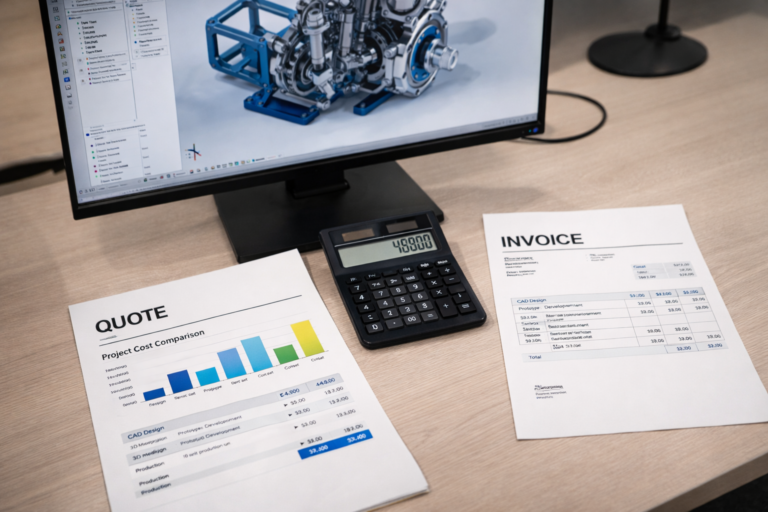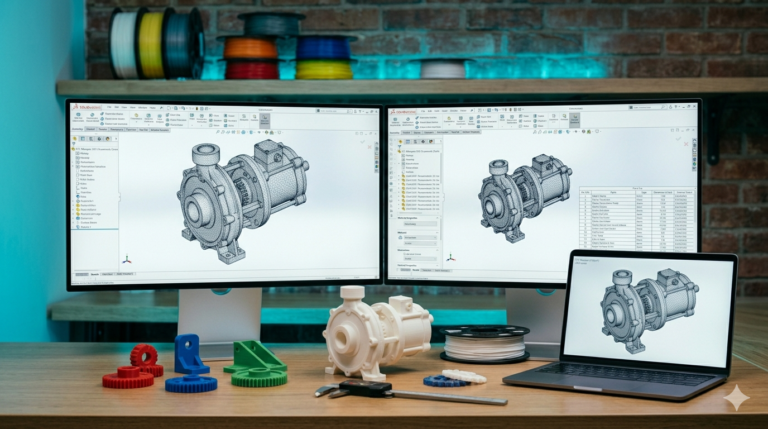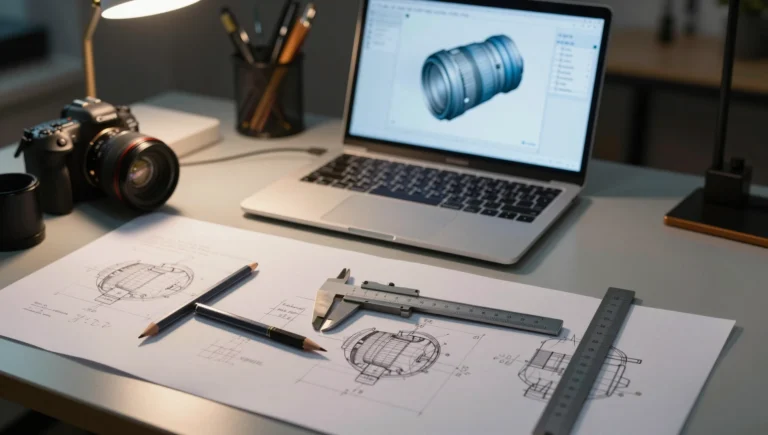
The question “what does 3D modeling cost” produces answers spanning from $5 (a student’s first freelance project) to $50,000+ (a complete automotive interior by a specialized design firm) — a range so wide it is functionally useless without context. Understanding 3d modeling service price requires breaking the cost into its component drivers: geometric complexity, manufacturing process awareness, deliverable depth, revision scope, and provider overhead structure. This guide provides real 2026 pricing data across every project type, complexity tier, and pricing model, drawn from our studio’s experience delivering 7,000+ projects spanning the full spectrum from $34 replacement brackets to $2,000+ complete product development packages.
3D Modeling Service Price by Complexity Tier
Tier 1 — Simple geometry (brackets, mounts, spacers, adapter plates, standoffs, simple covers): $34 to $69. These parts have 5 to 15 features, straightforward extrusions and cuts, standard hole patterns, and basic fillet/chamfer operations. A competent SolidWorks engineer completes a Tier 1 part in 1 to 3 hours including drawing. The output is a single SLDPRT, STEP, STL, and a one-sheet technical drawing with overall dimensions and critical tolerances noted.
Tier 2 — Moderate geometry (consumer product housings, electronics enclosures, mechanical linkages, custom jigs and fixtures, packaging inserts): $69 to $174. These parts have 15 to 40 features including shell operations, snap-fit hooks, ventilation patterns, connector cutouts, draft angles for molding, and multi-body geometry. Modeling time: 3 to 8 hours. The output includes the part model, STEP, STL with print-specific settings, and a multi-sheet drawing with section views and GD&T callouts on critical mating surfaces.
Tier 3 — Complex geometry (organic surfaced products, multi-component assemblies with 5 to 15 parts, mechanisms with motion, products requiring FEA validation): $174 to $500. These projects involve advanced surfacing, assembly-level interference checking, tolerance stack-up analysis, and manufacturing optimization for specific production processes. Modeling and analysis time: 8 to 25 hours. Deliverables expand to include assembly files, per-part drawings, BOM, and analysis reports where applicable.
Tier 4 — Full product development (complete products with 15+ components, motion mechanisms, electronics integration, packaging, renders, and production documentation): $500 to $2,000+. These engagements span 2 to 6 weeks and produce the complete engineering package needed for manufacturer quoting, tooling purchase, and production launch. The 3d model pricing guide at this tier is project-specific — quoted based on detailed scope discussion rather than standard rate cards, because the variation between a 15-component consumer gadget and a 40-component industrial instrument is too large for standardized pricing to remain accurate.
The Five Factors That Actually Determine 3D Modeling Cost
Factor one: feature count and geometric complexity. A part with 40 features costs 4 to 6 times more to model than a part with 8 features, regardless of physical size. A 10 mm watch component with 40 features costs more than a 500 mm shelf bracket with 8 features. When requesting a cost of 3d modeling quote, describe your part’s complexity in terms of feature count, surface types (flat versus curved versus organic freeform), and any advanced operations (surfacing, sheet metal bends, mold split lines) rather than providing only bounding box dimensions that reveal nothing about modeling effort.
Factor two: manufacturing process awareness. A model designed for 3D printing requires different engineering judgment than one designed for CNC machining or injection molding — draft angles, wall uniformity, tolerance compensations, and geometric constraints all vary by process. Designers who embed process-specific manufacturing awareness produce files that go directly to production. Designers who ignore the manufacturing method produce files that require rework at the manufacturer — rework that costs money, delays timelines, and creates friction in your supplier relationship. This manufacturing intelligence is invisible in the 3d modeling service price quote but profoundly affects total project cost including downstream manufacturing expenses.
Factor three: deliverable depth. A bare 3D model file (SLDPRT only) is the minimum deliverable and carries the lowest cost. Adding STEP export, STL for printing, and a basic dimensioned drawing increases the deliverable scope modestly. Adding full GD&T-annotated production drawings, FEA analysis reports, tolerance stack-up documentation, and photorealistic renders for marketing or investor materials significantly expands the deliverable package and the associated 3d modeling rates. Our standard pricing includes native files, STEP, STL, and basic drawings — the complete package most projects require without premium surcharges.

Hourly vs Fixed Pricing — Which Model Saves You Money
Fixed pricing wins when the project scope is well-defined and the deliverable is clear. You know the total cost before work begins, the provider absorbs the efficiency risk (if the job takes longer than estimated, their margin shrinks — not your budget), and budget approval is straightforward because the number is deterministic. Fixed pricing is the dominant model in the freelance CAD market for exactly this reason — it aligns buyer and provider incentives toward efficient, accurate first deliveries.
Hourly billing wins when the scope is genuinely exploratory — early-stage concept development where requirements change weekly, iterative mechanism design where each prototype test generates geometric modifications, or consulting engagements where the value is engineering judgment and problem-solving rather than specific geometry output. Expect $25 to $75 per hour for experienced 3D modeling professionals, with the primary rate determinant being geographic location rather than skill level. The Xometry manufacturing resources provides instant manufacturing quoting that helps convert hourly exploration time into fixed-scope production projects when the design stabilizes and the geometry is ready for manufacturer review.
Retainer agreements suit companies with ongoing, predictable 3d design service cost requirements — product line extensions, packaging iterations, engineering change orders, and continuous manufacturing support. Monthly retainers of $500 to $2,000 reserve 20 to 80 hours of dedicated engineering capacity at 15 to 20 percent below standard per-project rates, with priority scheduling and a dedicated engineer assignment that accumulates deep knowledge of your product line, manufacturing partners, and dimensional standards over time. The retainer model becomes cost-effective when your monthly design needs consistently exceed 15 to 20 hours — below that threshold, per-project pricing is more efficient because you pay only for actual delivered work rather than reserved capacity.
Hidden Costs That Inflate Your Actual 3D Modeling Expense
The quoted 3d modeling service price is your floor cost, not your ceiling. Revision cycles beyond included rounds add $15 to $50 per round. File format conversions charged separately (which should be standard but some providers unbundle) add $10 to $30 per format. Manufacturing rework caused by design errors — missing draft angles returned by your injection molder, tolerance errors discovered during assembly, overhang geometry that fails on the 3D printer — generates costs that are invisible in the design quote but very real in your total project budget. A $30 model that generates $150 in manufacturing rework and revision fees costs $180 total. A $69 model that delivers correctly, prints cleanly, and passes manufacturer review on the first submission costs $69 total.
Platform commissions are another hidden cost layer in the 3d model pricing guide equation. Fiverr charges sellers 20 percent on every transaction — a fee that either inflates the price buyers pay or reduces the engineering time the designer can allocate to the project within the quoted budget. Upwork charges 5 to 20 percent depending on billing history. Ordering directly through a studio website like minicad.io eliminates marketplace commissions entirely, directing the full project fee toward engineering effort rather than platform infrastructure overhead. On a $200 project, the commission savings of $20 to $40 is equivalent to getting an additional revision round or a more detailed drawing package at zero incremental cost.

Industry Benchmarks — What Companies Actually Pay for 3D Modeling
Enterprise product development departments at Fortune 500 companies typically pay $75 to $200 per hour for SolidWorks modeling from contracted engineering firms, with annual spend ranging from $50,000 to $500,000 depending on new product launch cadence. Mid-market product companies with $10 to $100 million in annual revenue typically spend $20,000 to $80,000 annually on external CAD modeling services at $40 to $100 per hour blended rates. Small businesses, startups, and independent inventors spend $1,000 to $10,000 per year on project-based engagements at $25 to $75 per hour effective rates.
These benchmarks reveal an important market reality: the 3d modeling service price floor has dropped dramatically over the past decade as high-speed internet enabled global talent access, cloud-based file sharing eliminated geographic friction, and marketplace platforms created transparent pricing competition that benefits buyers across all budget levels. A startup in 2016 paying $80 per hour to a local US freelancer for basic bracket modeling now pays $35 to $50 per hour for equivalent or superior output from an international studio with 7,000+ completed projects and a 4.9-star rating — a 40 to 55 percent cost reduction with equivalent or improved quality, enabled by operational efficiency and geographic cost advantages rather than reduced engineering standards.
When Paying More for 3D Modeling Is Justified
Premium 3d modeling rates above the standard range are justified in three specific scenarios. First, regulatory-compliant documentation — medical devices requiring FDA design history files, aerospace components requiring AS9100 quality records, and pressure vessels requiring ASME stamp-ready engineering packages carry documentation overhead that generalist studios cannot absorb at standard rates because the regulatory knowledge, template systems, and liability insurance required to certify these deliverables represent significant fixed costs that must be amortized across each project.
Second, deep domain specialization — fluid dynamics simulation for heat exchanger design, electromagnetic compatibility analysis for antenna enclosures, and acoustic performance optimization for speaker housings require niche expertise that commands premium pricing because the engineer talent pool with both CAD proficiency and domain-specific analytical skills is small relative to demand. Third, extreme urgency — deliverables needed in under 4 hours rather than the standard 24-hour turnaround require the provider to interrupt or reschedule existing committed work, incurring opportunity costs that justify 50 to 100 percent rush premiums.
For all other scenarios — which represent 90+ percent of the commercial 3D modeling market — standard pricing from a quality-focused affordable provider delivers equivalent or superior output compared to premium providers, because the engineering challenges are well within the capability envelope of experienced SolidWorks designers regardless of whether their studio operates from San Francisco or Alexandria. The cost of 3d modeling for standard mechanical parts, consumer products, enclosures, fixtures, and general assemblies should not require premium budgets when affordable professional alternatives exist with verified quality records spanning thousands of completed projects.
How to Get Accurate 3D Modeling Quotes Without Overpaying
Provide three critical inputs when requesting a 3d modeling service price quote: a dimensioned sketch or reference showing the part geometry (answering “what does it look like”), a description of the manufacturing process (answering “how will it be made”), and a list of required deliverables beyond the default file package (answering “what documentation do I need beyond the model”). These three inputs enable accurate quoting based on actual scope rather than worst-case assumptions that providers use to protect margins when project scope is ambiguous.
Compare at least two quotes for any project above $200, but compare total project cost — not just the headline rate. Ask each provider what is included in their base price, how many revision rounds are covered, what file formats are delivered, and who absorbs the cost of corrections when the provider makes an error. The lowest base price paired with the most restrictive revision policy frequently produces the highest total cost because every revision beyond round one becomes a billable event that the “affordable” base price did not prepare you to budget for.
Volume and Batch Pricing for Multi-Part Projects
Projects involving multiple parts designed as a coordinated set receive volume discounts at professional studios because the shared design context, standardized file organization, and consistent parametric conventions reduce per-part engineering time compared to independent single-part engagements. Typical volume discounts range from 10 percent (5 to 10 parts) to 20 percent (10 to 25 parts) to 25 percent (25+ parts). Drawing packages for multi-part assemblies benefit even more from batch pricing because the title block setup, drawing standard configuration, and BOM generation overhead are amortized across all parts rather than duplicated for each one independently.
Our 3d modeling rates at minicad.io include automatic volume discounts starting at 5 parts per project, with custom batch pricing available for large-scale projects exceeding 25 parts. Contact our team with your full project scope for a per-part quote that reflects the actual batch efficiency rather than the inflated single-part rate that most providers quote before discussing volume adjustments during scope negotiation.

Subscription and Retainer Pricing Models for Ongoing Needs
Companies with continuous 3d modeling service price requirements — monthly product line updates, ongoing engineering change orders, seasonal packaging refreshes, and regular prototype iteration cycles — benefit from retainer agreements that reserve dedicated engineering capacity at discounted rates. Monthly retainers of $500 reserve 20 hours of dedicated SolidWorks engineering at an effective rate of $25 per hour (versus $35 to $50 per hour on standard per-project pricing). Higher retainers of $1,000 to $2,000 reserve 40 to 80 hours with proportionally lower effective rates and priority scheduling that ensures your projects never queue behind other clients during peak demand periods.
The retainer model becomes cost-effective when your monthly design needs consistently exceed 15 hours — below this threshold, per-project pricing is more efficient because you pay only for delivered work. Above this threshold, the retainer discount compounds with the accumulated context advantage: your dedicated engineer already knows your product line dimensional standards, your manufacturing partner’s specific tolerance requirements, your preferred fastener specifications, and your brand’s design language for fillets, surface finishes, and component organization — knowledge that eliminates the setup and learning overhead that occurs with every new provider engagement and reduces per-project cost by an additional 15 to 25 percent beyond the explicit retainer discount.
Our retainer clients at minicad.io receive a dedicated engineer assignment, priority scheduling, a shared project archive with dimensional standards and material specifications documented for automatic application to future projects, and monthly progress reports summarizing completed work, active projects, and upcoming capacity availability for planning purposes. This structured relationship model transforms the traditional vendor-client transaction into a strategic engineering partnership that improves in speed, cost, and quality with every successive month of collaboration.
The ROI of Professional 3D Modeling — Calculating Real Value
Professional 3D modeling is not a cost center — it is an investment that generates measurable returns through reduced manufacturing rework, faster prototype iteration, and production-ready documentation that eliminates engineering change orders during manufacturing startup. A $69 SolidWorks model that produces a correct first prototype, passes manufacturer DFM review on first submission, and handles 10 revision cycles cleanly over a 3-year product lifecycle delivers 50 to 100 times its cost in prevented downstream expenses. The 3d design service cost should be evaluated against the alternative cost of not having professional engineering — which includes failed prints, manufacturer rejections, assembly incompatibilities, and the calendar time consumed by each problem resolution cycle that delays your product launch.
Explore real examples of this work in our portfolio — see our 2D technical drawing for manufacturing and custom NFC keychain multi-color print projects. Need professional engineering support? Our STL file design service and prototype design service deliver production-ready files in 24 hours.
Get Transparent 3D Modeling Pricing Today
Your 3d modeling service price should be clear, predictable, and comprehensive. At minicad.io, every quote includes native SolidWorks files, STEP, STL, technical drawings, and two revision rounds. No hidden fees, no format surcharges, no post-quote surprises. With 7,000+ projects and 4,470+ verified reviews confirming consistent quality and competitive 3d modeling rates, get a free quote within hours and know exactly what your project costs before any engineering begins.