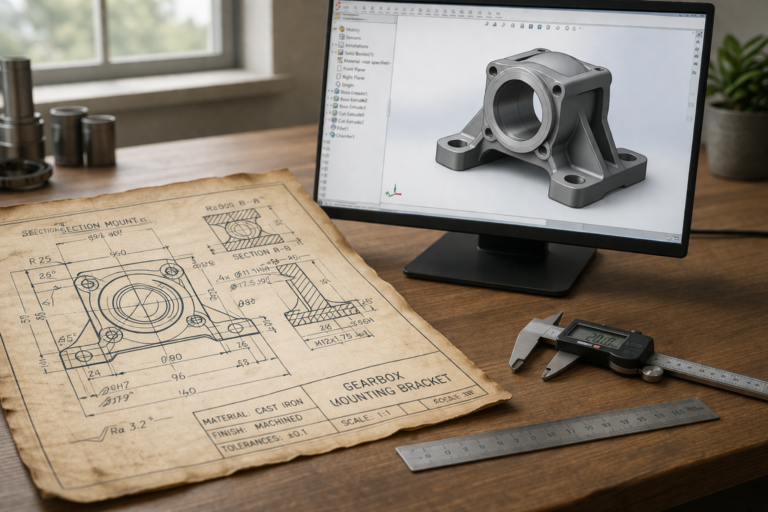
The solidworks or fusion 360 decision is the most consequential software choice a product designer, engineering team, or hardware startup makes during their first year — because the platform you choose determines your file compatibility with manufacturers, your talent pool for hiring or outsourcing, your simulation capabilities for validating designs before prototyping, and your long-term data ownership and sovereignty model for design files that may need modification years after the initial design is complete. Both platforms are genuinely capable professional tools, but they serve fundamentally different users with fundamentally different needs. This guide provides an honest, engineering-focused comparison based on hands-on experience with both platforms across thousands of delivered projects.
The Fundamental Architecture Difference
SolidWorks is a desktop-installed, locally-processed parametric modeler. Your files live on your hard drive, your CPU handles every calculation, and your license is yours perpetually (for perpetual license holders) or annually renewable (for subscription users). You can work offline, your files are never dependent on internet connectivity, and your modeling speed is limited only by your hardware — not by server latency or cloud processing queues.
Fusion 360 is a cloud-native platform that stores files on Autodesk servers, processes some operations locally and some in the cloud, and requires internet connectivity for full functionality. Your files are accessible from any device with a browser, collaboration features are built into the platform’s architecture, and the subscription model ($545 per year for commercial users in 2026) includes CAM, rendering, simulation, and PCB design capabilities that SolidWorks charges extra for as separate add-on modules.
This architecture difference creates a philosophical split. SolidWorks users own their files locally, have complete control over data access and backup, and are never affected by Autodesk’s server uptime or subscription policy changes. Fusion 360 users benefit from anywhere-access convenience, built-in version history, and a lower entry cost — but accept that their design data lives on Autodesk’s infrastructure, that feature availability can change with subscription tier modifications, and that working offline is possible only in a limited capacity with pre-cached files. Neither approach is universally better. The right choice depends on your specific data sovereignty requirements, collaboration needs, and long-term file ownership philosophy.

Parametric Modeling Capability Comparison
SolidWorks has 25+ years of parametric modeling development focused exclusively on mechanical design. Its feature tree, sketch constraints, assembly mates, and drawing generation tools are mature, deeply integrated, and thoroughly debugged across billions of user-hours. Complex operations — multi-body parts, advanced surfacing, mold split tools, sheet metal bending, weldment profiles, and routing (piping, tubing, electrical) — work reliably because they have been refined through decades of industrial use and user feedback from 3.5 million active licensees.
Fusion 360’s parametric modeling has improved dramatically since its launch but still trails SolidWorks in handling complex assemblies (performance degrades noticeably above 100 components), advanced surfacing (fewer surface analysis and repair tools), sheet metal design (limited bend table customization and flat pattern nesting), and large-scale drawing generation (fewer automated annotation tools and limited GD&T symbol libraries compared to SolidWorks Drawing). For simple to moderately complex parts — enclosures, brackets, consumer product housings with under 30 features — Fusion 360’s modeling experience is smooth and competitive. For complex assemblies, intricate mechanisms, and production-grade documentation packages, SolidWorks delivers more robust and reliable results with less workaround effort.
Manufacturing Ecosystem and File Compatibility
SolidWorks is the most commonly requested format by professional manufacturers worldwide. CNC shops, injection molders, sheet metal fabricators, and casting houses expect SLDPRT and STEP files from SolidWorks because their CAM software, quoting tools, and DFM analysis programs are built around that file format ecosystem. Sending a SolidWorks file to a manufacturer is a frictionless transaction that requires zero explanation or file conversion negotiation.
Fusion 360 exports to STEP, IGES, and STL — all formats that manufacturers can import — but the export path from Fusion 360 to STEP occasionally produces geometry anomalies (surface stitching errors, missing fillets, tolerance rounding artifacts) that do not appear in the native Fusion 360 viewport but cause import warnings or errors in the manufacturer’s CAD/CAM system. These anomalies are rare (perhaps 3 to 5 percent of exports for complex parts) but consequential when they occur — requiring re-export with different settings, manual geometry repair, or worst case, requesting the designer to rebuild the affected features. SolidWorks-to-STEP export reliability exceeds 99 percent for properly modeled geometry because the STEP translator has been refined across 25 years of production use and manufacturer feedback.
The SolidWorks official documentation provides detailed file format specifications and compatibility notes that help users understand the strengths and limitations of every export pathway from SolidWorks to neutral formats.

Simulation and Analysis Tools
SolidWorks Simulation (available in Professional and Premium editions) provides FEA stress analysis, thermal simulation, frequency analysis, buckling analysis, fatigue analysis, and nonlinear material simulation within the native SolidWorks environment. Results are directly associative with the parametric model — change a dimension, rebuild, and re-run the simulation in minutes without re-importing geometry or re-applying boundary conditions.
Fusion 360 includes simulation capabilities within the standard subscription — stress analysis, thermal analysis, modal frequency analysis, and shape optimization. For simple linear static analyses, Fusion 360’s simulation tools produce results comparable to SolidWorks Simulation. For advanced analyses — nonlinear materials, large deformation, contact mechanics, and fatigue life prediction — SolidWorks Simulation provides more analysis types, more solver options, and more mature post-processing tools. If your product requires FEA validation beyond basic stress checks, SolidWorks is the stronger platform; if you need only occasional simple stress verification, Fusion 360 covers the requirement adequately at no additional module cost.
Total Cost of Ownership — SolidWorks vs Fusion 360
Fusion 360 costs $545 per year for a commercial subscription including CAD, CAM, simulation, rendering, and PCB design. No upfront hardware investment beyond a computer capable of running the software. No additional module fees for standard features. The entry cost is the lowest in the professional CAD market by a significant margin.
SolidWorks Standard costs approximately $3,995 for the first year (perpetual license plus annual subscription for updates and support), with annual renewal at approximately $1,295. SolidWorks Professional (adding toolbox, rendering, ECAD integration) costs approximately $5,490 first year with $1,595 annual renewal. SolidWorks Premium (adding simulation, routing, tolerance analysis) costs approximately $7,995 first year with $1,995 annual renewal. These prices reflect the standalone license model; network and term license pricing differs.
The cost comparison appears to favor Fusion 360 overwhelmingly until you factor in three hidden variables. First, SolidWorks perpetual licenses retain value — you can use the last activated version indefinitely even without renewing the subscription, and you can resell the license at 40 to 60 percent of original purchase price. Fusion 360 subscription provides access only while the subscription is active; files remain accessible in view-only mode after cancellation, but editing, modification, or creation of new design versions requires full resubscription at the current published rate. Second, SolidWorks’ larger talent pool means hiring or outsourcing SolidWorks expertise costs less per hour than equivalent Fusion 360 expertise — the supply-demand economics of 3.5 million SolidWorks users versus approximately 500,000 Fusion 360 commercial users work in the buyer’s favor. Third, downstream compatibility savings — SolidWorks files going to manufacturers require zero conversion work; Fusion 360 files occasionally require export troubleshooting that costs engineering time and delays production start.

Collaboration and Team Workflows
Fusion 360 excels at cloud-native collaboration — multiple users can access the same project, version history is automatic, and design reviews happen through shared browser links without requiring the reviewer to install software. For distributed teams, startups with remote contributors, and design education environments, this frictionless collaboration model is Fusion 360’s strongest competitive advantage.
SolidWorks collaboration requires either a product data management (PDM) system (SolidWorks PDM Standard or Professional) for file versioning, access control, and revision tracking, or manual file management disciplines that require team discipline to maintain. PDM adds cost ($2,000 to $4,000+ per seat) and administrative overhead but provides enterprise-grade version control, approval workflows, and audit trails that Fusion 360’s built-in version history cannot match for regulated industries (medical devices, aerospace, automotive) where formal change control documentation is a compliance requirement rather than a convenience preference.
Talent Availability and Outsourcing Considerations
The SolidWorks talent pool is approximately 7 times larger than Fusion 360’s commercial user base. This ratio directly affects your ability to hire, outsource, and find specialized expertise for niche applications. On freelance platforms, SolidWorks designers outnumber Fusion 360 designers approximately 5 to 1, with the most experienced (1,000+ completed projects) found almost exclusively in the SolidWorks pool because the platform has been commercially available and continuously developed since 1995 while Fusion 360 launched as a commercial product in 2013, giving SolidWorks a 18-year head start in building its professional user community. This experience gap manifests in the depth and breadth of available SolidWorks expertise: specialists in injection mold design, sheet metal fabrication, medical device documentation, automotive tolerance analysis, and aerospace certification workflows exist in abundance in the SolidWorks talent pool but are rare or nonexistent among Fusion 360 specialists because these deep specializations require decades of platform-specific experience that Fusion 360 has not existed long enough to produce in volume. If your solidworks or fusion 360 decision affects outsourcing plans, SolidWorks provides more vendor options, more competitive pricing due to supply abundance, and deeper specialization in manufacturing-focused design work.
Our studio uses SolidWorks exclusively because 100 percent of our manufacturing partners accept native SolidWorks files, our engineering team has accumulated 9+ years of SolidWorks-specific experience and workflow optimization, and our clients’ downstream manufacturing processes integrate seamlessly with SolidWorks deliverables without format conversion overhead. For clients who have existing Fusion 360 files that need modification or expansion, we import via STEP and rebuild the parametric structure in SolidWorks — a one-time conversion cost that pays dividends through every subsequent revision cycle by placing the design in the more manufacturer-compatible format.

Technical Drawing and Documentation Comparison
SolidWorks Drawing is the most mature technical documentation tool in the mid-market CAD space. It generates fully associative 2D views from 3D models with automated dimensioning, balloon annotations, bills of materials, and comprehensive GD&T symbol libraries that cover both ASME Y14.5 and ISO 1101 standards completely. Drawing templates, title blocks, revision tables, and tolerance annotation tools have been refined across 25 years of production use by millions of engineers — the workflows are polished, predictable, and thoroughly documented in both official Dassault Systèmes documentation and thousands of community tutorials.
Fusion 360’s drawing environment has improved significantly but remains less capable for production-grade documentation. GD&T symbol support is more limited than SolidWorks (some advanced modifiers and datum reference frame configurations require manual text annotation rather than dedicated symbol tools). BOM generation does not integrate with enterprise ERP systems as seamlessly as SolidWorks’ BOM tools do through PDM-ERP connectors. And drawing template customization — essential for companies with established documentation standards that new drawings must match — is less flexible than SolidWorks’ template architecture. For teams that produce dozens of production drawings per month for manufacturers who expect ASME-compliant documentation, SolidWorks Drawing remains the more productive and reliable tool.
Data Management and File Ownership
The solidworks or fusion 360 data management question has practical implications that extend far beyond daily workflow convenience. SolidWorks files stored locally or on a company file server are owned by the license holder — they can be backed up independently, accessed offline indefinitely, archived on any storage medium, and migrated to future SolidWorks versions or exported to neutral formats at any time without dependency on any external service provider. If Dassault Systèmes went bankrupt tomorrow (extraordinarily unlikely for a company with $6 billion in annual revenue), your SolidWorks files would still open in your currently-installed software version forever.
Fusion 360 files are stored on Autodesk’s cloud infrastructure. If you cancel your subscription, files are accessible in read-only mode — you can view and export them but cannot edit, modify, or create new versions. If Autodesk changed their data retention policy, modified their subscription terms, or experienced a catastrophic infrastructure failure, your access to your own design data would be affected by decisions and events completely outside your control. For startups, this risk is usually acceptable — the cost savings and collaboration benefits outweigh the theoretical data sovereignty concern. For established companies with regulatory compliance requirements, long product lifecycles (10+ years of active production and support), or significant intellectual property value in their CAD file library, local file ownership is a non-negotiable requirement that favors SolidWorks decisively and makes the solidworks or fusion 360 question easy to answer for this category of buyer.
SolidWorks PDM (Product Data Management) provides enterprise-grade version control, access permissions, approval workflows, and audit trails for companies that need formal change management documentation. Medical device companies under FDA design controls (21 CFR Part 820), aerospace companies under AS9100, and automotive suppliers under IATF 16949 all require documented change history proving that every design modification was reviewed, approved, and traceable to a specific engineering change order. SolidWorks PDM provides this documentation infrastructure natively. Fusion 360’s version history provides basic change tracking but does not include the formal approval workflow, role-based access control, and regulated-industry audit trail capabilities that compliance frameworks require.
SolidWorks or Fusion 360 — Our Honest Recommendation
Choose Fusion 360 when: you are a solo designer or small team without enterprise PDM needs, your projects involve simple to moderate geometry (under 30 features, under 20 assembly components), your budget prioritizes lowest possible entry cost, you value cloud-native collaboration over local file control, and your manufacturing partners accept STEP files without requiring native SolidWorks format. Fusion 360 is an excellent tool for these specific use cases and should not be dismissed based on platform snobbery or uninformed bias. Choosing the right tool for your actual requirements is smart engineering — choosing the most expensive tool to signal professional status is wasteful ego spending that diverts budget from more productive investments.
Choose SolidWorks when: your projects involve complex assemblies (50+ components), advanced surfacing, sheet metal design, or production-grade technical documentation with full GD&T, your manufacturing partners expect native SolidWorks files, your hiring or outsourcing strategy depends on the largest available talent pool, your industry requires formal PDM-controlled change management for regulatory compliance, or your file ownership philosophy requires local data control independent of any cloud service provider’s business continuity. SolidWorks is the industry standard for mechanical product design for reasons that extend far beyond modeling capability — the ecosystem, the talent pool, and the manufacturing compatibility advantages compound over the entire product lifecycle.
Explore real examples of this work in our portfolio — see our custom nozzle diffuser manifold design and custom brackets and mounts in SolidWorks projects. Need professional engineering support? Our STL file design service and prototype design service deliver production-ready files in 24 hours.
Get Professional SolidWorks Design Today
Whichever platform you choose for your internal work, our studio delivers every project in SolidWorks — the format that every manufacturer on the planet can use without conversion friction. With 7,000+ projects delivered, a 4.9-star rating from 4,470+ verified reviews, and 24-hour delivery on most single-part jobs, minicad.io provides the SolidWorks engineering expertise that maximizes your design’s manufacturing compatibility and downstream value. Get a free quote and experience the difference professional SolidWorks modeling makes — regardless of which solidworks or fusion 360 direction your internal team follows.