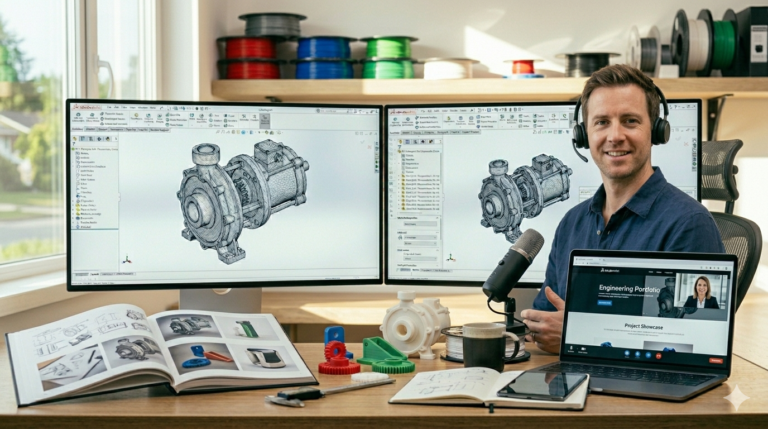
Searching online for solidworks design services returns thousands of providers — from solo freelancers working out of home offices to full-service engineering firms with fifty-person teams and enterprise contracts. The challenge is not finding someone who owns a SolidWorks license. The challenge is finding a provider who delivers production-quality, fully parametric files that your manufacturer can use without rework, without clarification calls, and without discovering critical design errors during tooling or first-article inspection. This guide explains what to evaluate, what to demand in every delivery, and where smart buyers find consistent quality.
What Solidworks Design Services Actually Include
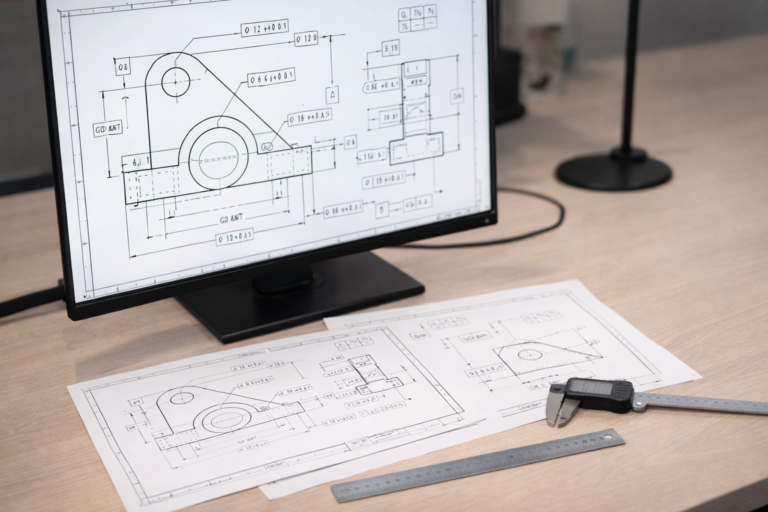
At minimum, a professional solidworks cad service delivers three core deliverables: parametric 3D part models saved as native SLDPRT files, assembly files (SLDASM) when multiple components are involved, and 2D technical drawings (SLDDRW) exported to both PDF for quick reference and DWG for manufacturers who use AutoCAD-based workflows. Many reputable providers also include STEP exports for vendor-neutral file sharing and STL files for 3D printing — both should be standard inclusions, not premium upsells that inflate the project cost.
Higher-tier service packages add finite element analysis (FEA) for stress and thermal simulation, motion studies for mechanism validation, photorealistic rendering for marketing and investor materials, and detailed design-for-manufacturing (DFM) feedback covering draft angles, wall uniformity, undercuts, and tooling considerations. These extras justify premium pricing when your project genuinely requires them, but a simple mounting bracket does not need a full FEA study. A load-bearing structural component in a safety-critical assembly absolutely does. Knowing the difference saves you from both underspending on critical analysis and overspending on unnecessary services.

How to Evaluate Quality Before You Commit
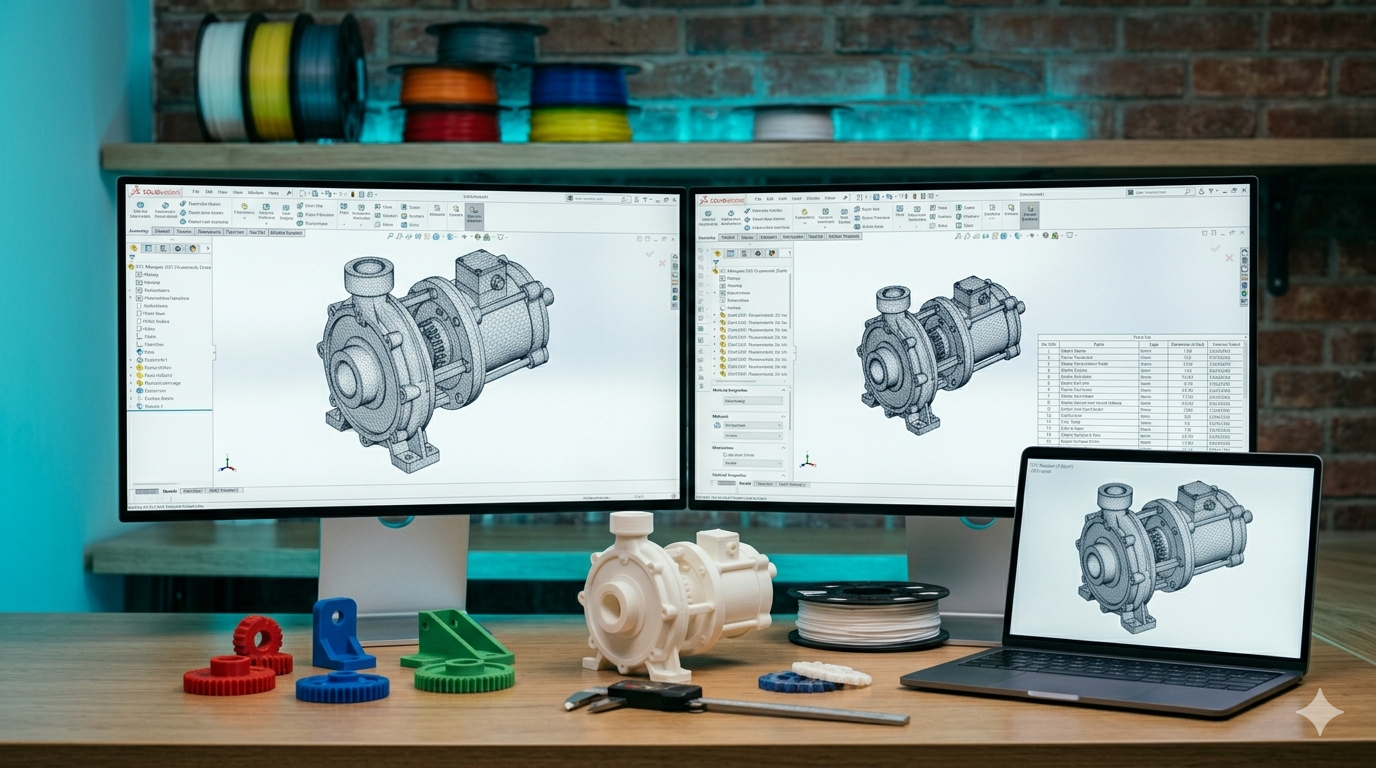
Request a sample feature tree screenshot from a completed past project. Professional solidworks modeling follows a logical, readable sequence — base sketch with full dimensional constraints, primary extrusion establishing the core shape, secondary features adding functional geometry, fillets and chamfers for stress relief and aesthetics, then manufacturing-specific features like draft, shell, and rib operations. The tree should read like a recipe that another engineer can follow and modify, not a random pile of operations that only the original creator understands.
Named features are a critical quality indicator. Entries like Boss-Handle, Cut-USB-Port, and Shell-1.5mm communicate design intent to anyone who opens the file months or years later. Generic entries like Boss-Extrude47 and Cut-Extrude12 indicate a designer who builds models quickly but does not document them for future use. If you plan to modify the design later — and most product designs go through multiple revisions over their lifecycle — named features save hours of reverse-engineering effort.
Check whether the provider delivers fully defined sketches, meaning every line, arc, and dimension is constrained with geometric relations and numerical values, showing no blue (underdefined) geometry anywhere. Underdefined sketches are the number one cause of models that break unpredictably when you change a single dimension. A circle without a fixed center point can shift position when you modify an unrelated feature, cascading errors through the entire feature tree. Fully defined sketches prevent this entirely and represent a non-negotiable quality standard that separates professional solidworks design services from amateur modeling.
Pricing Structures for SolidWorks Services
Three pricing models dominate the market for solidworks engineering service providers. Fixed-price per deliverable works best for clearly defined, well-scoped projects: $34 to $69 for a single part with technical drawing, $69 to $174 for multi-part assemblies with standard complexity, and $174 or higher for complex projects involving organic surfaces, advanced surfacing techniques, or multi-configuration family parts. Fixed pricing gives you cost certainty before work begins, and the provider carries the risk if the job takes longer than their internal estimate.
Hourly billing suits open-ended projects where the scope evolves as the design develops — common during early-stage product exploration when requirements change weekly. Expect $25 to $75 per hour depending on geographic location and specialization depth. Monthly retainer agreements reserve dedicated engineering capacity at discounted rates, typically 10 to 20 percent below standard project pricing. Retainers work well for product companies with continuous design needs — new SKU development, packaging iteration, and ongoing manufacturing support throughout the product lifecycle.
The biggest cost driver is geometric complexity, not physical part size. The Xometry manufacturing resources library provides excellent reference data on how complexity affects quoting across different manufacturing processes. A 10 mm watch component with 40 features, tight tolerances, and multi-axis machining considerations costs significantly more to model than a 500 mm shelf bracket with 8 simple features. Always describe your part’s feature count, manufacturing method, and tolerance requirements when requesting a quote — this produces far more accurate pricing than sharing only overall bounding box dimensions.

Industry Specialization Matters More Than You Think
A designer who primarily models consumer electronics enclosures approaches a medical device housing fundamentally differently than they would a consumer product — even if the geometry looks superficially similar. Medical devices require documentation trails, biocompatibility considerations for material selection, and awareness of FDA design controls that consumer product designers rarely encounter. Similarly, automotive components carry specific tolerance standards, material certifications, and environmental testing requirements that general-purpose CAD providers may not understand.
When evaluating solidworks design services for industry-specific work, ask whether the provider has delivered projects in your industry vertical within the past 12 months. Recent, relevant experience means the designer already understands the regulatory framework, standard manufacturing processes, and typical tolerance requirements for your product category — saving you from educating them on your industry fundamentals during a project you are paying them to complete efficiently.
Our studio handles projects across consumer electronics, kitchen products, industrial enclosures, outdoor equipment, medical instrument housings, and automotive accessories. This breadth means we understand cross-industry design patterns — how a snap-fit that works for a consumer product case differs from one designed for an industrial environment, why the same PETG material choice that suits a home gadget fails in a vehicle interior, and which solidworks engineering service deliverables each industry’s manufacturers actually need versus what designers typically provide by default.
Realistic Turnaround Expectations
A single part with moderate geometric complexity takes 4 to 8 hours of focused modeling time in the hands of an experienced SolidWorks engineer. With a 24-hour delivery commitment, your completed file package arrives the next business day. Multi-part assemblies containing 10 or more components typically require 3 to 5 business days of dedicated effort. Full product development projects — spanning concept exploration through production-ready drawing packages — run 2 to 6 weeks depending on revision cycles, client feedback speed, and manufacturing validation requirements.
Beware of providers who promise complex multi-component assemblies in 24 hours without asking detailed technical questions about your requirements first. Speed without quality produces files that look superficially finished on screen but fail at the manufacturer — missing draft angles that prevent mold release, interference between components that were never checked, and dimensions that reference the wrong datum. Our studio delivers most single-part jobs within 24 hours because we have the team depth, process discipline, and accumulated experience to maintain quality at speed — but we always set accurate timeline expectations based on the actual project scope rather than telling clients what they want to hear.
File Format Deliverables You Should Demand
Never accept a solidworks design company that delivers only STL mesh files as the final output. STL is a triangulated surface approximation — you cannot edit individual dimensions, add parametric features, or modify tolerance callouts within an STL file. Always demand native SolidWorks files (SLDPRT for parts, SLDASM for assemblies, SLDDRW for drawings) plus STEP for manufacturer compatibility. If your project involves 3D printing, request STL at a specified mesh resolution appropriate for your printer. If sheet metal fabrication is involved, request DXF flat patterns for direct laser cutting. Every project we deliver at minicad.io includes native files, STEP, STL, and PDF technical drawings as standard — no extra charge, no negotiation required. This is baseline professional practice, not a competitive differentiator — any solidworks design services provider who charges separately for standard file format exports is padding the invoice with deliverables that should be included by default.
The Revision Process — What Is Fair and Standard
Two to three revision rounds included in the base project price is the industry standard for solidworks design services. Each revision round should address all accumulated feedback points in a single comprehensive pass — not one fix per email exchange. Beyond the included rounds, additional revisions billed at an hourly rate or a fixed per-round fee are reasonable and expected. What is never reasonable is a provider charging extra for correcting their own errors — mistakes in dimension interpretation, missing features that were clearly specified in the brief, or geometric errors that violate the stated manufacturing method should always be corrected at zero additional cost.
Document all revision feedback using clearly marked-up screenshots with color-coded annotations, annotated PDFs with specific callout bubbles identifying each requested change, or the structured revision checklist template we provide to every client through our project management workflow at minicad.io. Structured feedback keeps the revision process efficient, prevents miscommunication about which features need modification, and typically reduces total revision rounds from three or four down to one or two — saving time for both the client and the engineering team. When structured correctly, revisions become a collaborative refinement process rather than a source of friction and escalating cost.
Explore real examples of this work in our portfolio — see our custom NFC keychain multi-color print and custom nozzle diffuser manifold design projects. Need professional engineering support? Our outsource CAD design service and technical drawing service deliver production-ready files in 24 hours.
How to Choose the Right Provider
Verify the provider uses SolidWorks as their primary daily tool — not as an occasional secondary platform they touch only when a client specifically requests it. Check review volume and recency — reviews from the past 30 days carry more weight than reviews from three years ago because they reflect current team capability, communication responsiveness, and consistent process quality under real production workloads. Look for industry specialization relevant to your project — consumer products, medical devices, industrial equipment, and automotive components each carry unique tolerancing standards, regulatory compliance requirements, and manufacturing process knowledge that generalist designers with broad but shallow experience across multiple sectors may lack entirely.
Our studio at minicad.io has delivered 7,000 or more projects across 40 countries spanning consumer electronics, kitchen products, industrial enclosures, medical instrument housings, and automotive accessories. Whether you need a single part modeled from a napkin sketch or a complete production-ready drawing package for a 30-component assembly, get a free quote and experience what professional solidworks design services should feel like — fast, precise, thoroughly documented, and fully transparent at every stage from initial quote through final validated file delivery, comprehensive post-delivery support, and ongoing revision availability.