The days of spending $2,000 on a product photography session before your first unit ships are over. 3d product rendering creates photorealistic images directly from your CAD model — images so accurate that buyers, investors, and even your own team cannot distinguish them from traditional studio photography. For modern ecommerce sellers, crowdfunding creators, and product companies launching across multiple channels simultaneously, rendering has become the default visual production method because it delivers higher quality, faster turnaround, lower cost per image, and unlimited variation capability that physical photography simply cannot match at any price point.
What 3D Product Rendering Actually Produces
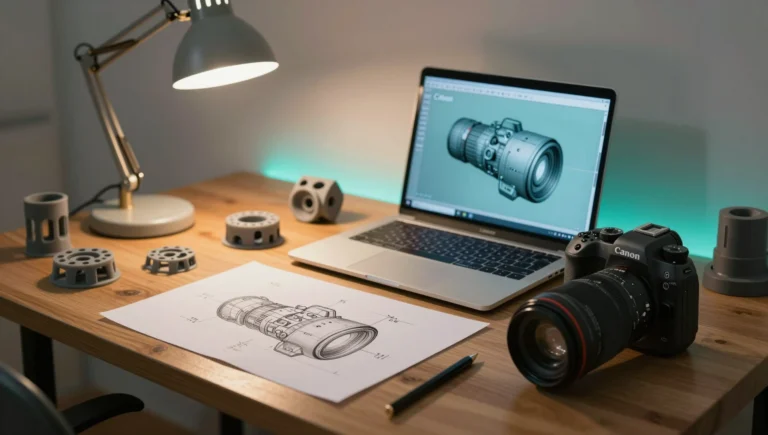
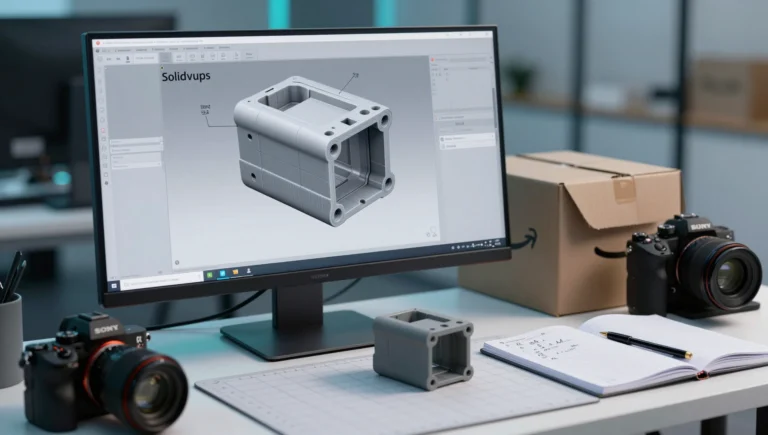
A photorealistic 3d render starts with a SolidWorks or STEP 3D model of your product. Visualization software applies physically-accurate material properties to every surface — the exact reflectivity of brushed aluminum, the subsurface scattering of translucent silicone, the micro-texture of injection-molded ABS plastic, the fingerprint-prone gloss of a polished chrome accent. A virtual studio environment provides lighting — HDR image-based illumination that replicates specific real-world lighting conditions from studio softboxes to outdoor sunlight to retail shelf fluorescents. Virtual cameras with physically-modeled lens properties (focal length, aperture, depth of field, lens distortion) compose the shot, and the rendering engine calculates how billions of light rays interact with every material surface to produce a final image pixel by pixel.
The output is a 3000 by 3000 pixel minimum image (meeting Amazon’s recommended resolution for zoom functionality) in PNG format with transparent background for compositing flexibility, or JPEG format for lifestyle contexts where the background is part of the intended visual. Each image undergoes color calibration to ensure the rendered product appears identical on iPhone screens, desktop monitors, and printed marketing materials — preventing the “it looked different online” returns that erode profit margins and tank seller ratings on competitive marketplace platforms.
The Cost Advantage of 3D Product Rendering Over Photography
A single Amazon-compliant product photography session costs $300 to $800 when you factor in sample shipping, studio rental, photographer fees, and post-processing editing. That session produces images for one product variant — one color, one material finish, one configuration. Every additional variant requires either a separate physical sample and session (multiplying the cost linearly) or digital color manipulation in Photoshop (which experienced buyers recognize as fake because lighting interactions with different materials and colors are physically distinct and cannot be replicated by hue-shifting a photograph).
A photorealistic 3d render of the same product costs $30 to $60 for the hero image, and each additional color or material variant costs only $20 to $50 because the geometry, lighting, and camera setup are already configured — only the material shader properties change. For a product sold in 8 colors, photography costs $2,400 to $6,400 for hero images alone. Rendering costs $190 to $410 for the same deliverable set. The savings fund your PPC advertising launch budget, additional product development, or inventory purchases — resources that directly accelerate revenue generation rather than being consumed by visual content production overhead.
The timeline advantage is equally significant. Photography requires a physical sample — which requires completed tooling, which requires finalized design. Rendering requires only a finalized CAD model, which exists weeks or months before the first physical production unit. This timeline gap enables pre-launch marketing campaigns, crowdfunding page preparation, Amazon listing optimization, and investor materials production to proceed in parallel with manufacturing rather than sequentially waiting for production samples to arrive before any visual content work can begin.
Ecommerce 3D Render Applications That Drive Sales
Hero images on white backgrounds are the entry point — every marketplace listing needs them, and renders produce pixel-perfect results that pass automated image quality checks without manual background editing. But the conversion-driving power of ecommerce 3d render content extends far beyond basic hero shots. Lifestyle renders showing the product in realistic use contexts increase click-through rates by establishing immediate relevance — a potential buyer scrolling through search results stops on the image that shows the product solving their specific problem in an environment that looks like their own kitchen, desk, or workshop.
360-degree turntable animations allow buyers to inspect the product from every angle, replicating the in-store experience of picking up and rotating a physical product. These interactive views reduce return rates by giving buyers complete visual information before purchase, eliminating the “it was smaller than I expected” and “the texture is different than I thought” objections that drive a disproportionate share of ecommerce returns for physical products. Exploded view renders reveal internal construction quality and component count, justifying premium pricing by demonstrating engineering substance that competitors with cheaper products and lower-quality listings cannot visually communicate.
Size comparison renders place your product next to recognizable reference objects — a hand, a smartphone, a standard coffee mug — communicating physical scale with an immediacy that dimension text cannot match. Material detail close-up renders show texture, finish quality, and tactile surface characteristics at magnification levels that standard product photography cannot achieve without expensive macro lens setups that most product photography studios do not own. Each render type addresses a specific buyer objection in the purchase decision funnel, systematically removing barriers to conversion across every image slot in your listing or product page layout.

Quality Signals That Separate Professional Renders from Amateur Work
Amateur 3d product rendering reveals itself through several telltale artifacts. Overly uniform lighting that creates an artificial, computer-generated appearance lacking the subtle light falloff and color temperature variation present in real photography. Materials that look “plasticky” regardless of the intended surface — a sign that the renderer applied generic material presets instead of calibrating physically-accurate shader properties for each specific material. Impossibly sharp focus across the entire image with no depth of field — real cameras cannot produce perfectly sharp images from foreground to background, and renders without simulated DOF trigger subconscious “this is fake” recognition in viewers who have spent a lifetime looking at photographs.
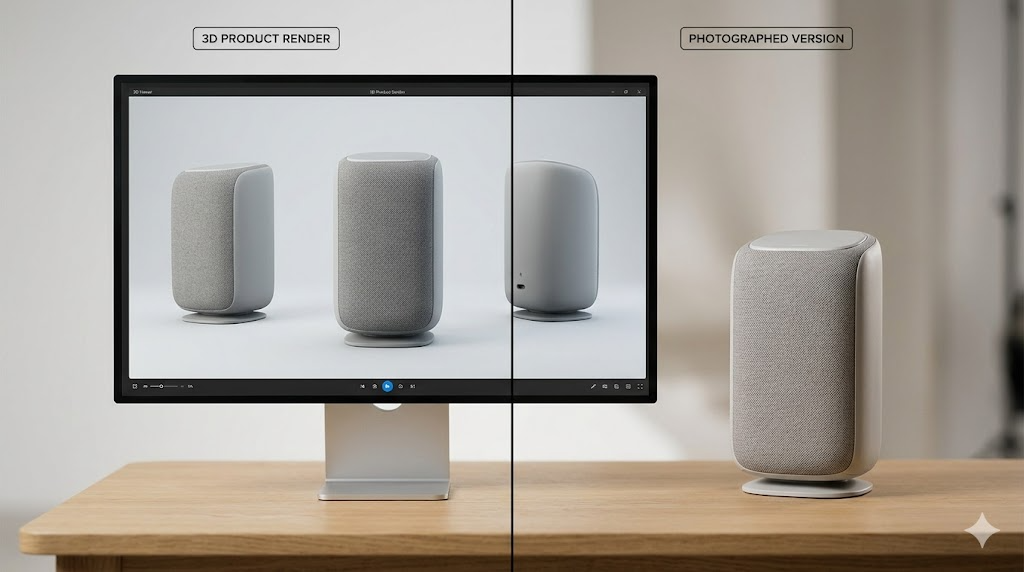
Professional rendering addresses every one of these quality signals. Physically-based lighting using HDR environment maps produces natural light behavior including soft shadows, specular highlights that follow Fresnel equations, and ambient occlusion in crevices. Material properties are calibrated to match real-world measurements — IOR (index of refraction) values, surface roughness micron values, and subsurface scattering profiles that produce renders indistinguishable from photographs when placed side by side. Camera simulation includes realistic depth of field, subtle chromatic aberration, and natural vignetting that subconsciously communicates “real photograph” to viewer perception. The difference between amateur and professional 3d product rendering is not artistic talent — it is physics accuracy. Professional rendering software calculates light behavior using the same equations that govern real-world photon interaction with physical surfaces. When the simulation inputs (material properties, light sources, camera parameters) are correctly calibrated, the output is physically indistinguishable from a photograph because it is computed using the same optical physics that cameras capture. The Formlabs engineering blog publishes excellent reference renders demonstrating physically-accurate material rendering across engineering plastics, metals, and elastomers.
Multi-Channel Visual Content from a Single Rendering Investment
A single set of 3d product rendering source files produces visual content for every marketing channel simultaneously. The 3000 by 3000 pixel hero render crops to Amazon’s required 1:1 ratio, Shopify’s flexible aspect ratio, and Instagram’s 4:5 feed format without re-rendering. The lifestyle render adapts to Facebook ad creative (1200 by 628 pixels), Pinterest pins (1000 by 1500 pixels), and email marketing headers (600 by 200 pixels) through simple cropping and resizing from the high-resolution source. The turntable animation exports as a looping GIF for product pages, an MP4 for social media, and individual frame captures for additional still image needs.
This multi-channel efficiency means your rendering investment produces 30 to 50 individual content assets from 7 to 10 source renders — a content multiplication factor that makes professional rendering dramatically more cost-effective per-asset than any alternative visual production method. Compare this to traditional photography, where each output format requires either a separate shot (vertical for Pinterest, horizontal for Facebook, square for Instagram) or compromised cropping from a single composition that was not designed for multi-format extraction.
For brands launching simultaneously across Amazon, their own Shopify store, social media advertising, and email marketing campaigns, the rendering-first workflow enables all visual content production to proceed in parallel with manufacturing rather than sequentially waiting for production samples. This parallelism compresses the overall launch timeline by 4 to 8 weeks — an acceleration that captures early market share, establishes search ranking momentum, and generates revenue weeks before competitors who followed the traditional photograph-after-production sequence begin their listing optimization process. For seasonal products where the launch window is fixed by calendar — holiday gifts, outdoor summer gear, back-to-school accessories — this timeline compression is the difference between capturing the peak buying season and missing it entirely with a perfectly photographed listing that arrives two months late.
Working with a Rendering Provider — What to Expect
The optimal workflow begins with a mood board exchange — share 3 to 5 reference images showing the visual style, lighting mood, and composition approach you want your renders to achieve. This 10-minute alignment conversation eliminates an entire revision round by ensuring the first output already matches your aesthetic expectations in overall tone, avoiding the expensive scenario where the provider delivers renders in a style fundamentally different from what you envisioned and the entire batch needs to be re-rendered from scratch.
After mood board alignment, the provider produces 1 to 2 sample renders for approval before completing the full batch. Review these samples for material accuracy (does the aluminum look like aluminum, not chrome), lighting quality (are shadows natural, not overly dark or absent), and color fidelity (does the blue match your Pantone specification, not a generic “blue” that varies by monitor). Approving the samples locks in the visual direction, and the remaining renders in the batch follow the same settings for guaranteed consistency across the full image set delivered to your listing or campaign page.
Explore real examples of this work in our portfolio — see our custom 3D printed storage container and 2D technical drawing for manufacturing projects. Need professional engineering support? Our prototype design service and SolidWorks modeling service deliver production-ready files in 24 hours.
Get Photorealistic 3D Renders for Your Product
Your product’s visual presentation directly determines its conversion rate — there is no shortcut past this reality in ecommerce. Professional 3d product rendering from a SolidWorks CAD model produces the listing images, campaign visuals, and marketing materials that compete at the highest quality tier in every marketplace category. With 7,000+ projects delivered, a 4.9-star verified rating from 4,470+ reviews, and experience rendering products for Amazon, Kickstarter, Shopify, and direct-to-consumer brands, our team at minicad.io delivers the photorealistic visual quality your product deserves. Get a free quote and see your product in studio-quality renders before the first production unit ships.