You have an idea that solves a real problem — a better mechanism, a smarter enclosure, a tool that does not exist yet. But between that idea and a patentable, prototypable, manufacturable product sits a gap that most independent inventors cannot cross alone. A professional invention design service bridges that gap by translating your concept into precise SolidWorks CAD geometry, producing patent-quality technical drawings, delivering 3D-printable prototype files, and documenting every engineering decision so your intellectual property is protected, your prototype is functional, and your path to manufacturing is clearly defined from day one of the project.
What an Invention Design Service Delivers
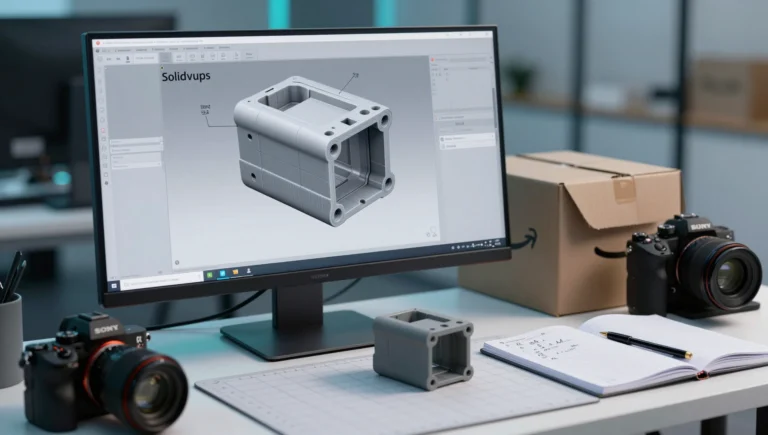
A comprehensive inventor cad service engagement produces five interconnected deliverables from a single SolidWorks model. First, the parametric 3D model — fully constrained geometry with named features, design intent documentation, and manufacturing process awareness embedded in every dimension. Second, patent-quality technical drawings — multi-view orthographic projections with dimensions, section views revealing internal features, and exploded views showing component relationships, formatted to meet USPTO patent filing guide utility patent drawing requirements. Third, prototype-ready STL files — mesh exports optimized for FDM or SLA 3D printing with orientation notes and print settings recommendations included.
Fourth, neutral format exports (STEP) for manufacturer communication — enabling any production partner worldwide to import, review, and quote your design without SolidWorks license requirements. Fifth, a design documentation package — material recommendations, manufacturing process options with estimated per-unit cost ranges at different production volumes, and a design rationale summary explaining key engineering decisions that a patent attorney can reference when drafting claims that accurately describe the inventive elements of your product.
This five-deliverable package gives you everything needed to file a patent application, produce a physical prototype, solicit manufacturer quotes, and present your invention to potential licensees or investors — all from a single project engagement rather than five separate vendor relationships that do not communicate with each other.

Patent Drawing Service — Meeting USPTO and WIPO Requirements
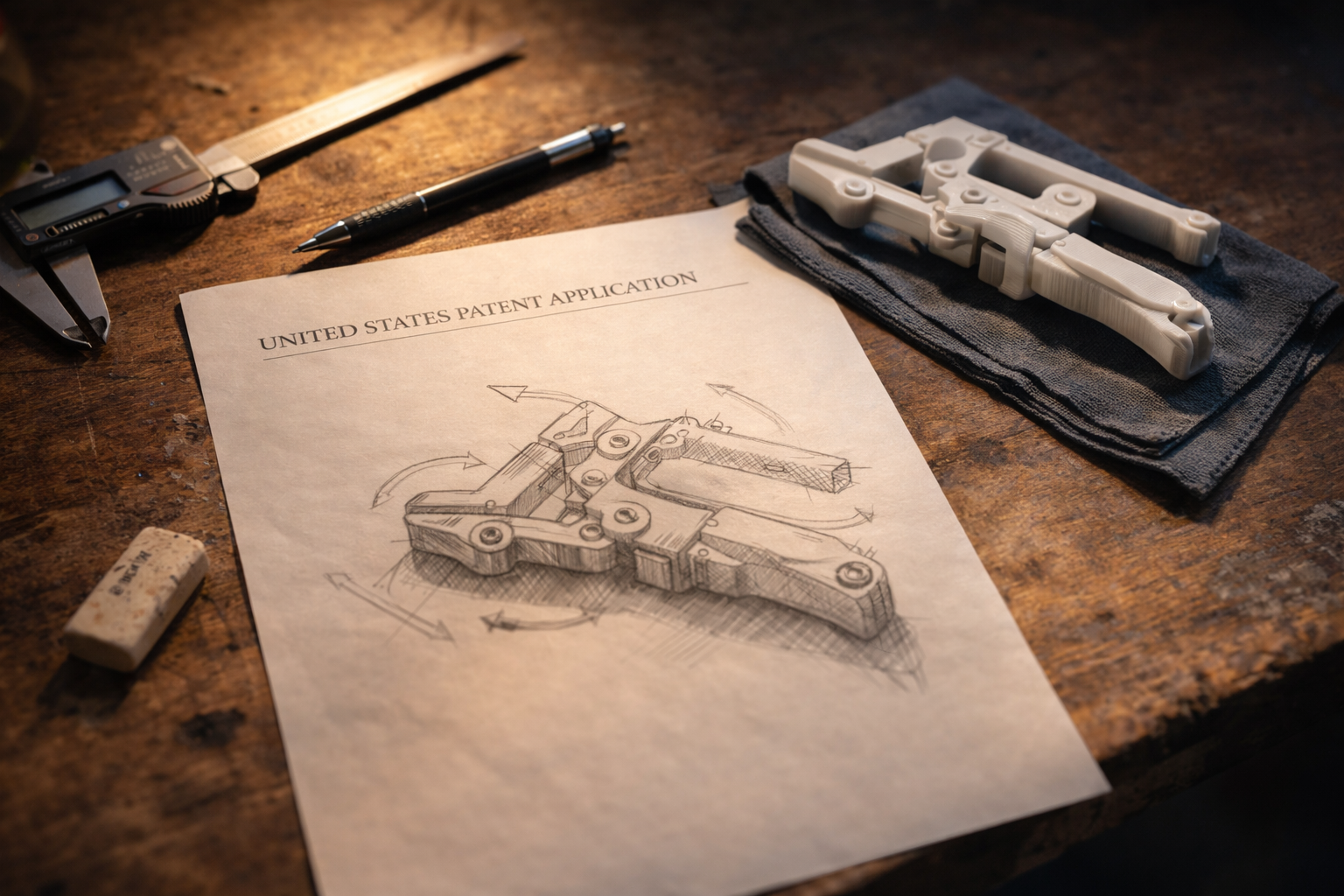
Patent drawings are not engineering drawings — they serve a different audience and follow different formatting rules. The USPTO patent filing guide requires drawings that clearly illustrate the inventive features with sufficient detail for a person skilled in the art to understand the invention without examining a physical sample. Drawings must use consistent reference numerals that correspond to the patent specification text. Shading and cross-hatching indicate material sections and surface characteristics. Multiple views (front, rear, side, top, bottom, perspective) show the complete geometry from every angle relevant to the claims.
Our patent drawing service produces formal patent illustrations directly from the SolidWorks model — not hand-traced approximations that introduce dimensional inaccuracies. Each drawing is formatted to meet USPTO formal drawing requirements (margin specifications, sheet numbering, figure labeling conventions) and international WIPO PCT application standards for inventors pursuing protection in multiple countries. Reference numerals are coordinated with a legend document that your patent attorney uses directly in the specification text, eliminating the back-and-forth where the attorney must interpret unlabeled drawings and assign their own numbering scheme.
For design patents, where the visual appearance of the product is the protected intellectual property rather than the functional mechanism, we produce the seven standard views (front, rear, left side, right side, top, bottom, perspective) plus any additional detail views needed to fully disclose the ornamental design features that distinguish your product from prior art. Design patent drawings require precise line weight control, consistent shading patterns, and elimination of all functional annotations (dimensions, callouts) that are appropriate for utility patents but prohibited in design patent figures.
Translating an Invention Concept into CAD Geometry
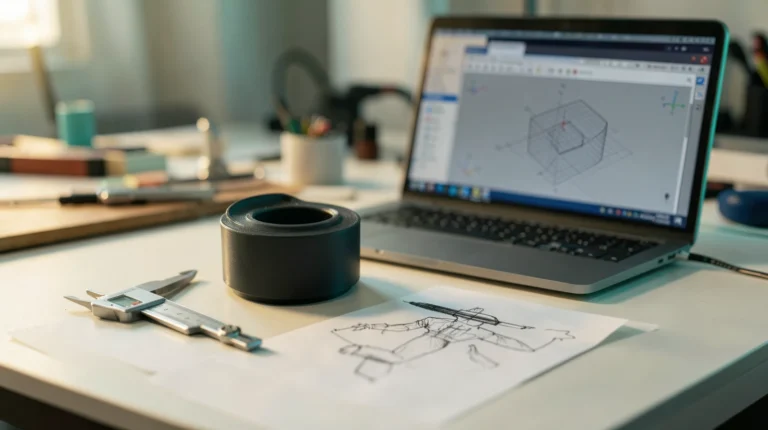
Most inventions arrive at our studio as hand sketches with approximate dimensions, verbal descriptions of how the mechanism works, photographs of rough proof-of-concept mockups built from household materials, or competitor products with annotations showing where the inventor’s improvements apply. An invention prototype design project begins by extracting precise dimensional requirements from these conceptual inputs — determining which dimensions are critical (they affect function or patentability), which are flexible (they can be optimized during design), and which are constrained by external factors (mating with existing products, fitting standard packaging, complying with industry dimensional standards).
For mechanism-based inventions, we build a kinematic model first — a simplified SolidWorks assembly that captures the motion paths, pivot locations, cam profiles, and linkage geometries that define the inventive mechanism. This kinematic model validates that the intended motion is physically achievable before we invest hours detailing housing geometry, cosmetic surfaces, and manufacturing features that depend on the mechanism working correctly. Discovering a kinematic problem (insufficient range of motion, interference between moving parts, excessive actuation force) early in a simplified model costs 30 minutes of engineering time. Discovering the same problem in a fully detailed model costs hours of rework.
For enclosure-based inventions (new product housings, storage solutions, protective cases), the design process starts with the internal components that must be accommodated — PCB dimensions, battery sizes, connector locations, ventilation requirements — and builds the enclosure outward from those constraints. This inside-out approach ensures that the enclosure fits its contents precisely rather than the common failure mode where an aesthetically-driven exterior shape gets finalized first and the internal components do not fit, requiring geometry compromises that harm both appearance and function.
Prototyping Your Invention Before Patent Filing
A physical prototype serves three purposes for inventors. First, functional validation — confirming that the mechanism works as intended under real-world conditions, that the ergonomics feel right in human hands, and that the product interacts correctly with its intended environment (a kitchen tool in a real kitchen, a bike accessory on a real bike, a desk organizer on a real desk with real items in it). Second, patent strengthening — a working prototype with documented performance data makes patent claims more defensible and licensing presentations more convincing than claims backed only by CAD models and theoretical analysis.
Third, manufacturing feasibility verification — a 3D-printed prototype reveals whether the designed geometry is actually producible, whether assembly sequence is practical, and whether material properties meet functional requirements under real-world loads. The most common prototyping surprise for inventors is discovering that a mechanism that moves smoothly in a SolidWorks motion study encounters binding, excessive friction, or insufficient clearance in the physical print — insights that SolidWorks simulation cannot predict because they depend on surface finish, material elasticity, and dimensional accuracy variations that exist in printed parts but not in mathematically perfect CAD geometry.
Our invention modeling deliveries include print-ready STL files with recommended orientation and settings for FDM prototyping. For inventors without access to a 3D printer, we provide referrals to service bureaus that produce single-part prototypes for $10 to $50 depending on size, material, and process. The total investment for a complete invention prototype — CAD modeling, patent drawings, and physical prototype print — typically ranges from $100 to $300 for single-component inventions: a fraction of what traditional prototyping shops charged just a decade ago, when CNC machining was the only rapid prototyping option available and minimum project fees started at $500 before a single chip was cut. The democratization of 3D printing has fundamentally changed the economics of invention prototyping — making physical validation accessible at price points that individual inventors and bootstrapped startups can afford without external funding or institutional support. This accessibility means there is no longer any financial excuse for skipping the physical prototype step before committing to patent filing or manufacturing investment.
Protecting Your Intellectual Property Throughout the Design Process
File a provisional patent application before sharing detailed sketches, dimensions, or functional descriptions with any external party — including your CAD designer, 3D print service bureau, potential manufacturer, or investor who has not signed an NDA. A provisional filing with the USPTO patent filing guide costs approximately $320 for micro-entities (most independent inventors qualify) and establishes a priority date that protects your concept for 12 months while you validate the design, produce a prototype, and prepare the full patent application with your attorney.
Every invention design service project at our studio includes automatic NDA coverage — your sketches, CAD files, communications, project metadata, and all deliverables remain confidential without requiring separate legal negotiation. We do not retain copies of client files after project completion and final payment, do not publish or reference client projects in marketing materials without explicit written consent, and do not discuss project details with any third party for any reason. This confidentiality protection is a baseline professional obligation that every legitimate design service provides as default practice, not a premium service tier or optional add-on.
For inventors working with patent attorneys, we provide direct technical communication support — answering attorney questions about design intent, manufacturing feasibility, and material selection rationale that strengthen patent claim language. This collaboration between the design engineer (who understands the geometry) and the patent attorney (who understands the legal framework) produces stronger applications than either professional working in isolation from the other.
Common Mistakes Inventors Make During the Design Phase
The most expensive mistake independent inventors make is perfecting aesthetics before validating function. Surface finish, color, brand mark placement, and packaging design are important — but they are irrelevant if the core mechanism does not work reliably, if the ergonomics are uncomfortable during sustained use, or if the product dimensions do not fit the intended use environment. Our invention design service sequences deliverables specifically to prevent this mistake: functional geometry first (validates the mechanism), prototype testing second (validates real-world performance), cosmetic refinement third (optimizes appearance for manufacturing and market presentation). Founders who follow this sequence reach market-ready status 40 to 60 percent faster than those who attempt simultaneous perfection across all three dimensions.
The second most costly mistake is skipping competitive patent landscape research before investing in detailed CAD modeling. A $300 to $500 patent landscape search by a qualified patent attorney — examining existing patents, published applications, and prior art in your product’s technology area — takes 2 to 3 weeks and answers the critical question: is your invention novel enough to warrant the $5,000 to $15,000 full patent prosecution investment? Discovering a blocking patent after spending $2,000 on detailed CAD modeling and prototyping wastes both money and months of calendar time. Discovering it before CAD modeling begins allows you to redesign around the prior art while the investment is still minimal — a $0 geometry change in your concept sketch versus a $500 model rebuild after the CAD work is complete.
The third common mistake is sharing detailed invention information with potential manufacturers, investors, or business partners without a signed NDA and provisional patent filing in place. Verbal agreements to “keep it confidential” have zero legal enforceability. A $320 provisional patent filing and a one-page NDA template (available free from numerous online legal template services) provide meaningful legal protection that costs a fraction of the intellectual property value at risk. Every inventor cad service engagement at our studio includes automatic NDA coverage, but protection with third parties beyond our studio requires your own legal documentation that we strongly encourage completing before any external disclosure.
Designing for Both Licensing and Self-Manufacturing Simultaneously
Many inventors are uncertain whether they will license their invention to an established company or manufacture and sell it themselves — and the optimal commercialization strategy often does not become clear until after the prototype is built and market response is tested. Our invention prototype design deliverable structure accommodates both paths from a single SolidWorks model. The parametric source files, STEP exports, and technical drawings serve the self-manufacturing path directly. The photorealistic renders, product one-sheet, and engineering summary serve the licensing path. Rather than committing to one commercialization strategy before the engineering begins, you receive deliverables that keep both options open until real-world market data informs the decision.
For inventors pursuing licensing, we prepare a supplementary deliverable package: a one-page product summary with key specifications, target market description, competitive advantage summary, and a hero render — the document a licensing manager at a consumer products company can evaluate in under three minutes and forward internally with a recommendation. For inventors pursuing self-manufacturing, we prepare production-specific documentation: manufacturer-ready STEP files with tolerance specifications, packaging CAD models with FBA or retail dimensional compliance verification, and a preliminary bill of materials with component sourcing specifications. Both packages are available as standard additions to the base invention modeling engagement at incremental cost rather than requiring separate project engagements with different providers.
Preparing Your Invention for Licensing or Manufacturing
If your strategy is licensing rather than self-manufacturing, your deliverable package needs additional elements beyond the standard CAD model and patent drawings. Licensee presentation materials including photorealistic renders that show the product in its intended use context, an engineering summary document that communicates the invention’s technical advantages without disclosing proprietary details covered by your patent application, and a one-page product sheet with market positioning, target customer profile, and competitive advantage summary that a licensing decision-maker can evaluate in under five minutes.
If your strategy is self-manufacturing, the deliverable emphasis shifts to production-readiness: STEP files formatted for your target manufacturer’s CAD system, technical drawings with manufacturing-specific tolerances (injection molding, CNC, sheet metal), material specifications with approved vendor sourcing options, and a bill of materials listing every component with purchase specifications. Our invention design service adapts deliverables to your commercialization strategy — licensing-optimized or manufacturing-optimized — based on a brief strategy discussion during the project intake phase.
Cost and Timeline for Invention Design Projects
Single-component inventions (tools, accessories, simple mechanisms) cost $69 to $174 for complete CAD modeling with patent drawings and prototype STL files, delivered within 24 to 72 hours. Multi-component inventions with mechanisms, assemblies, and interaction between moving parts cost $174 to $500 with 3 to 7 business day turnaround. Complex inventions requiring FEA validation, mechanism analysis, or multi-material design cost $500 to $1,500 over 2 to 4 weeks. Patent drawing-only services (when the 3D model already exists) cost $50 to $120 per figure set. All prices include native SolidWorks files, STEP, STL, patent drawings, and two revision rounds.
For inventors on limited budgets, we offer a phased approach — starting with the minimum deliverable set needed for provisional patent filing (3D model plus patent drawings at $69 to $120), then expanding to full prototype files, production documentation, and rendering in subsequent phases as funding allows. This staged investment approach protects your IP filing deadline while deferring larger engineering expenses until the concept is validated and funding is secured.
Explore real examples of this work in our portfolio — see our custom NFC keychain multi-color print and custom nozzle diffuser manifold design projects. Need professional engineering support? Our prototype design service and SolidWorks modeling service deliver production-ready files in 24 hours.
Turn Your Invention into Engineering Reality
The distance between a great idea and a patented, prototyped, manufacturable product is shorter and more affordable than most inventors expect. With 7,000+ projects delivered across 40+ countries, a 4.9-star rating from 4,470+ verified reviews, and dedicated experience translating inventor concepts into SolidWorks models, patent drawings, and functional prototypes, our team at minicad.io delivers the invention design service that transforms your concept into protected intellectual property with a clear path to market. Get a free quote, upload your sketch, and take the critical first engineering step toward making your invention physically real and legally protected with professional engineering documentation behind every design decision.