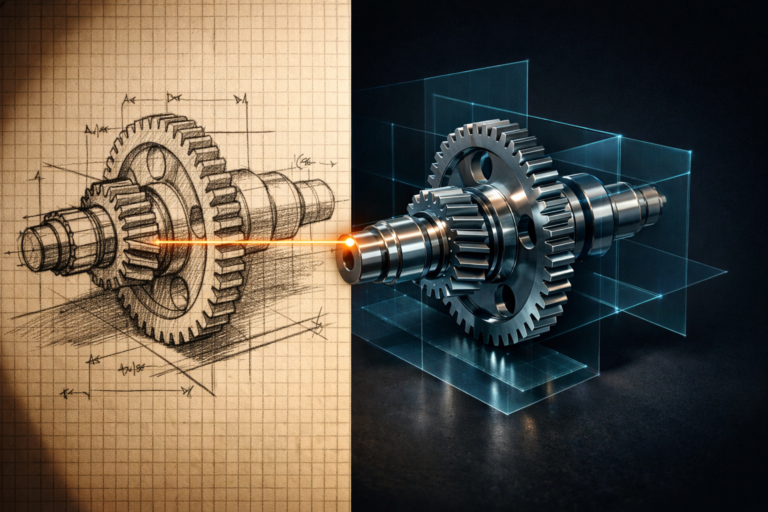
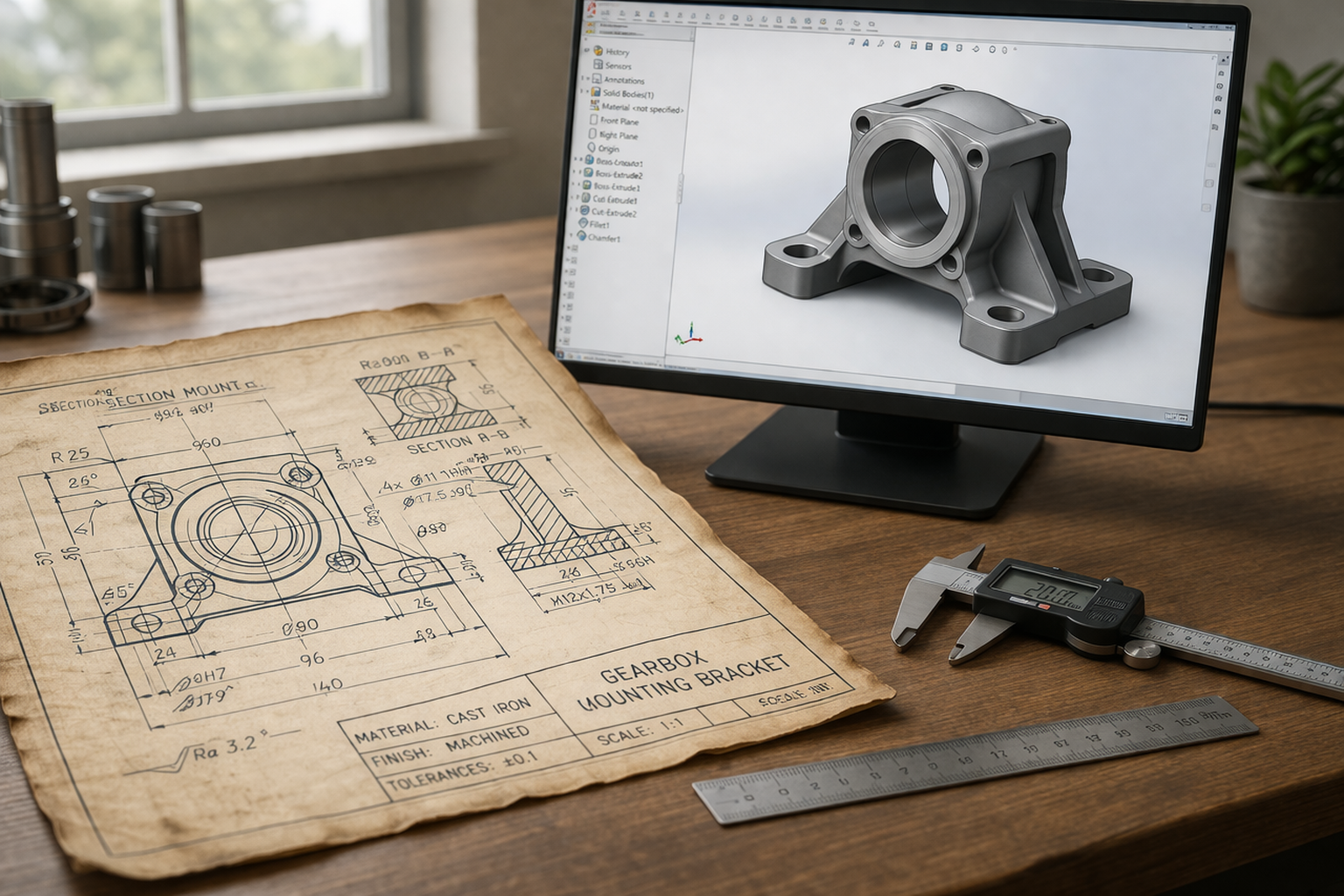
Thousands of engineering drawings created in the era of drafting boards and 2D AutoCAD still define products in active production today. But modern manufacturing, 3D printing, and CNC programming all require 3D models — not flat drawings. A reliable 2d to 3d cad conversion workflow transforms those legacy blueprints, hand-drawn sketches, and flat DWG files into fully parametric SolidWorks models that work with every modern manufacturing process, simulation tool, and visualization platform without losing any of the critical dimensional or tolerance information encoded in the original drawing.
When You Need a 2D to 3D CAD Conversion
Four scenarios drive demand for convert 2d drawing to 3d services. First, legacy modernization — companies with libraries of 2D drawings from the 1970s through 2000s that need 3D models for CNC programming, 3D printing, or FEA simulation that 2D formats cannot support. Second, reverse engineering — recreating discontinued parts from their original manufacturing drawings when the physical parts are worn, damaged, or unavailable for 3D scanning. Third, manufacturing transitions — moving production from a manual machining shop that worked from 2D prints to a CNC facility that requires 3D STEP or IGES files.
Fourth, design modification — updating existing products where only 2D drawings survive because the original 3D files were lost in software migrations, company acquisitions, or storage system failures. In all four scenarios, the deliverable is a fully parametric SolidWorks model that captures the original design intent with proper constraints, named features, and manufacturing-aware geometry — not just a visual replica of the 2D drawing extruded into the third dimension without engineering judgment.
The Professional 2D to 3D Modeling Workflow
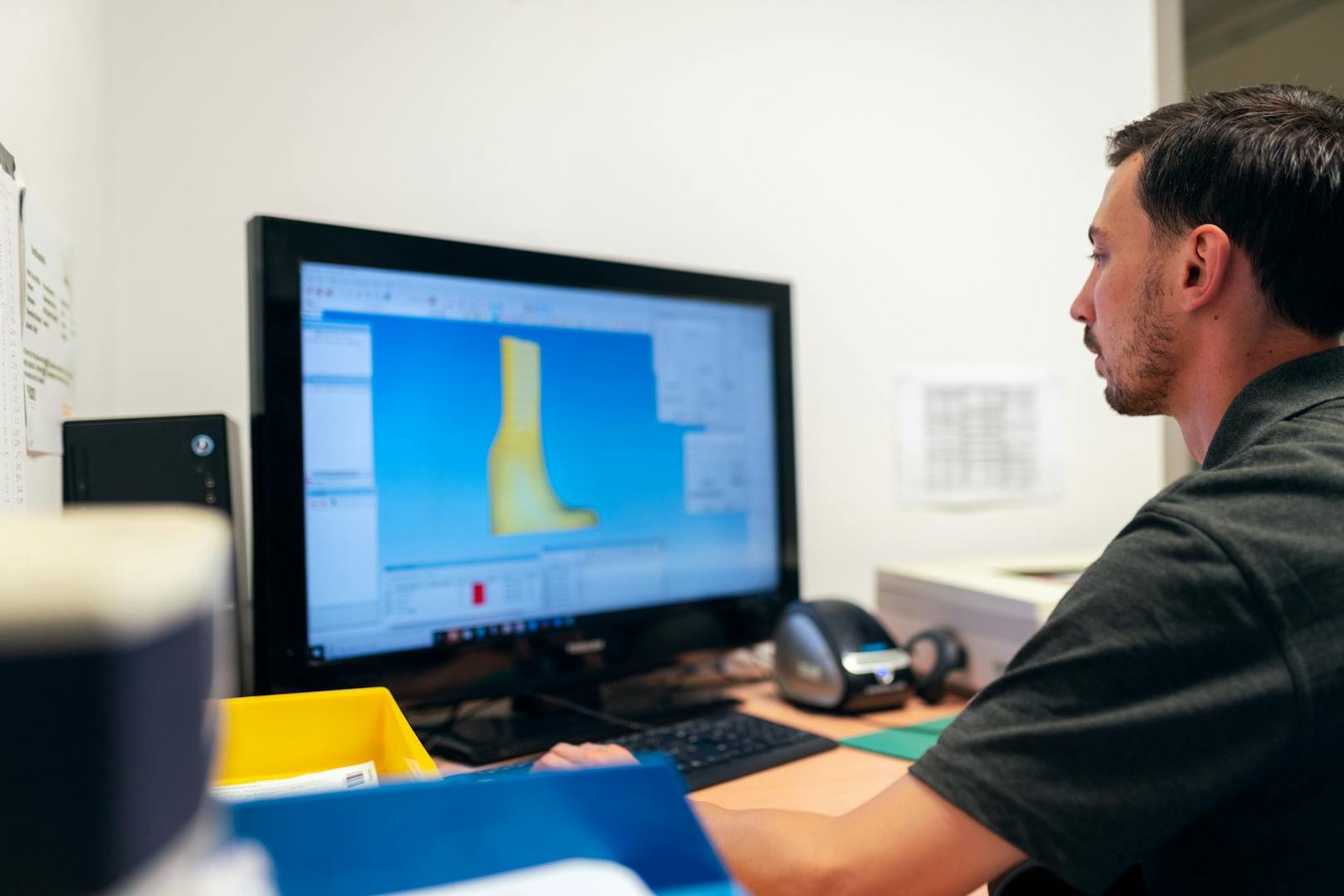
Our 2d to 3d cad conversion process follows a structured five-step sequence. First, drawing assessment — we examine the source drawing for completeness, checking whether all views are dimensioned, whether section views reveal internal features, and whether notes specify material, finish, and tolerance standards. Missing information is flagged and clarified with the client before modeling begins, preventing assumptions that create costly revision cycles later.
Second, dimension extraction — we transcribe every dimension, tolerance, surface finish callout, and geometric control from the 2D drawing into a structured reference document. For hand-drawn sketches where dimensions are approximate, we discuss critical versus non-critical dimensions with the client to determine where exact values matter and where reasonable engineering judgment can fill gaps. Third, SolidWorks modeling — building the part from the extracted dimensions using proper parametric technique: base sketch, primary extrusion, secondary features, fillets, draft, shell, and pattern operations in logical sequence with fully defined sketches throughout.
Fourth, verification — overlaying the completed 3D model dimensions against the original drawing to confirm that every critical dimension matches within the specified tolerance. For flat drawing to cad conversions where the original drawing uses first-angle projection (common in European and Asian drawings), we verify that projection convention is correctly interpreted, since confusing first-angle and third-angle projection produces mirror-image geometry that is dimensionally correct but physically wrong. Fifth, export and delivery — generating SLDPRT, STEP, STL, and dimensioned 2D drawings from the 3D model so the client has both the parametric source and the production documentation in every needed format.
Common Challenges in 2D to 3D Conversion
Incomplete dimensions are the most frequent obstacle. Legacy drawings often relied on the machinist’s experience to fill gaps — a common practice when the drawing creator and the manufacturer worked in the same building and could discuss ambiguities in person. When converting these drawings decades later, those informal agreements are lost. We handle incomplete dimensions by calculating derived values from available geometry (if two of three related dimensions are present, the third can be computed), referencing industry standards for common features like screw thread depths and counterbore diameters, and explicitly confirming all assumptions with the client through annotated markup documents before finalizing any dimension we cannot extract directly from the drawing.
Projection convention confusion — confusing first-angle projection (ISO standard, used in Europe and most of Asia) with third-angle projection (ASME standard, used in North America) — produces models where features appear on the wrong face, holes are positioned on the mirror-image side, and symmetry assumptions create doubled or missing geometry. Our engineers verify projection convention from the drawing’s title block symbol before modeling begins, and when the symbol is absent or unclear, we confirm convention with the client using a simple reference sketch that eliminates ambiguity in under two minutes. The SolidWorks official documentation provides clear visual references for both projection standards that we share with clients when this question arises.
Converting Scanned Paper Blueprints to 3D Models
Paper blueprints and hand-drafted drawings present additional challenges beyond digital DWG files. Scanned images have variable resolution, dimension text may be partially illegible, and scaling accuracy depends on the scanner calibration and paper condition. For blueprint to 3d model conversions, we work from the highest-resolution scan available (300 DPI minimum, 600 DPI preferred), manually extract every readable dimension, and flag any illegible or ambiguous values for client clarification before modeling begins.
When paper blueprints include tolerance annotations in now-obsolete standards (British Standard 308, pre-1989 DIN standards), we translate them into equivalent ISO or ASME tolerance values on the new 3D drawing. This translation ensures that the converted model’s documentation is compatible with modern manufacturing quality systems and inspection equipment without requiring the manufacturer to reference historical standards they may not have access to.
Quality Standards for Converted 3D Models
A properly converted model is not just geometrically equivalent to the original 2D drawing — it must also be parametrically structured for future modification and manufacturing-aware for direct use in CNC programming or 3D printing without additional engineering work. This means fully defined sketches (no blue underdefined geometry), named features following a logical sequence, proper datum references that align with the part’s manufacturing fixture strategy, and tolerances applied at the drawing level using GD&T symbology appropriate for the manufacturing process.
Our quality verification process overlays every critical dimension from the original drawing against the completed 3D model using SolidWorks inspection tools. Any discrepancy exceeding the original drawing’s tolerance specification is flagged and corrected before delivery. For drawings without explicit tolerances, we apply ISO 2768-mK general tolerances as the baseline standard — the same default tolerance class used by most precision machine shops when a drawing does not specify otherwise.
Verification and Dimensional Accuracy Confirmation
Every 2d to 3d cad conversion must include a formal verification step that compares the completed 3D model against the original source drawing dimension by dimension. Our verification process uses the SolidWorks Inspection tool to generate a balloon-numbered drawing overlay that maps every dimension from the original 2D document to the corresponding measurement in the 3D model. Discrepancies exceeding the original drawing’s tolerance specification are flagged, investigated, and corrected before delivery. For drawings that do not specify individual tolerances, we apply ISO 2768-mK medium tolerance class as the default verification standard — the same baseline used by most precision manufacturing facilities when processing drawings without explicit tolerance callouts.
For critical dimensions — mating surfaces, bore diameters, thread specifications, and datum references — we perform a secondary verification pass using SolidWorks Measure tool to confirm absolute dimensional accuracy to three decimal places. This dual-verification approach catches errors that single-pass checking misses, particularly in complex parts where a dimension in one view constrains a feature visible only in a different sectional view of the original drawing.
Batch Conversion Projects — Converting Entire Drawing Libraries
Companies with legacy drawing archives of 50, 200, or even 1,000+ drawings face a unique challenge — the conversion project is too large for ad-hoc part-by-part processing but too varied for fully automated conversion. Our batch conversion workflow addresses this by combining standardized processes for common drawing types (prismatic parts, turned parts, sheet metal parts, weldment assemblies) with individual engineering attention for complex or ambiguous drawings that require interpretation beyond straightforward dimension transcription.
Batch projects begin with a drawing audit — we categorize every drawing by complexity level (simple, moderate, complex, incomplete), identify common part families that share geometric patterns, and flag drawings requiring client clarification before modeling can begin. This triage step produces an accurate project scope, realistic timeline, and per-drawing cost estimate that reflects actual complexity rather than a flat rate that overcharges simple parts and undercharges complex ones.
For convert 2d drawing to 3d projects spanning 100+ drawings, we assign a dedicated engineering team with a single point of contact, weekly progress reports showing completed versus remaining drawings, and quality metrics tracking first-pass accuracy rates. Typical throughput is 5 to 15 drawings per day per engineer depending on complexity mix, with batch completion timelines of 2 to 8 weeks for archives of 50 to 300 drawings. Volume pricing at 15 to 20 percent below individual conversion rates applies to all batch projects, making legacy modernization more financially accessible than the per-drawing math initially suggests.
Our 2d to 3d modeling team has converted drawing libraries for manufacturing firms transitioning from manual machine shops to CNC facilities, replacement part suppliers digitizing catalogs for online ordering systems, and engineering consultancies modernizing client archives acquired through corporate mergers. Each scenario presents unique challenges — different drawing standards, different projection conventions, different tolerance baseline assumptions — that our extensive cross-industry 2d to 3d cad conversion experience handles without the steep learning curve a specialized provider would face when encountering an unfamiliar drawing convention for the first time and must learn through trial and error on your project rather than through prior accumulated experience.
Explore real examples of this work in our portfolio — see our custom 3D printed storage container and 2D technical drawing for manufacturing projects. Need professional engineering support? Our technical drawing service and product rendering service deliver production-ready files in 24 hours.
Pricing and Turnaround for 2D to 3D Conversion
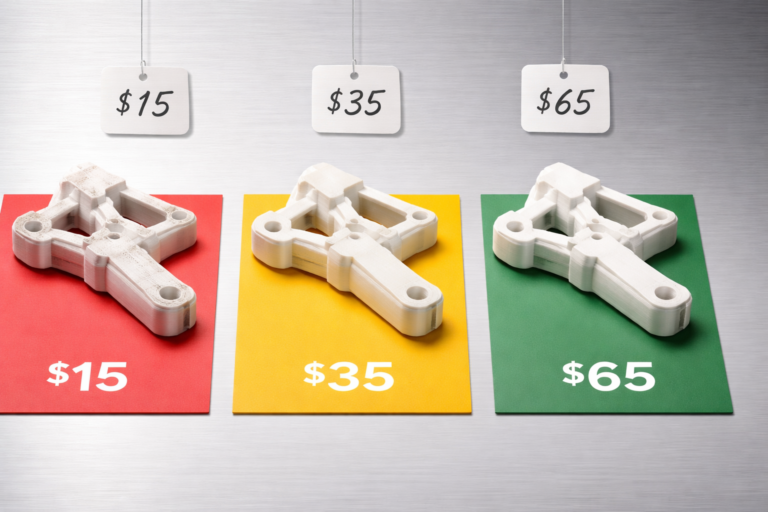
Single-part 2d to 3d cad conversion projects with clear, complete drawings cost $34 to $69 and deliver within 24 hours. Parts with incomplete dimensions requiring clarification rounds run $69 to $120 with 2 to 3 business day turnaround. Batch conversions of 10 or more drawings receive volume pricing at 15 to 20 percent below individual rates, with dedicated engineering capacity assigned for consistent quality and accelerated throughput. Full legacy library modernization projects spanning hundreds of drawings are quoted per-drawing with milestone-based delivery schedules.
Every 2d to 3d cad conversion delivery from our studio at minicad.io includes native SLDPRT, STEP, STL, and a new 2D drawing generated from the 3D model documenting all dimensions and tolerances — giving you a complete, modern engineering package that replaces the original legacy drawing entirely. Get a free quote for your conversion project — whether it is a single drawing or an entire archive. With 7,000+ projects delivered, a 4.9-star rating, and 24-hour turnaround on straightforward conversions, we deliver the quality and speed your modernization timeline demands.