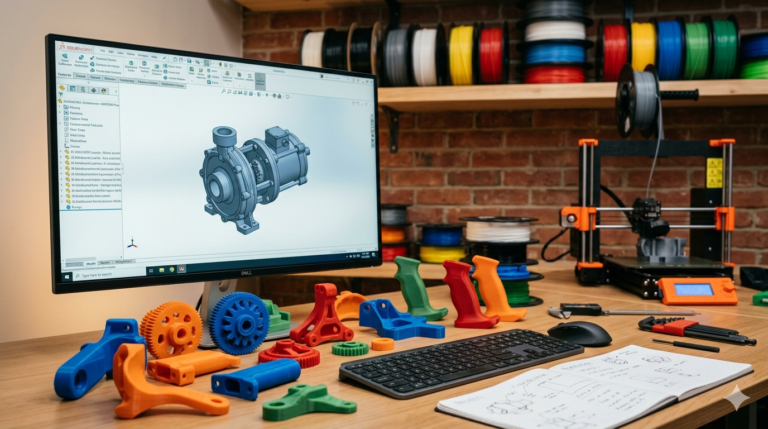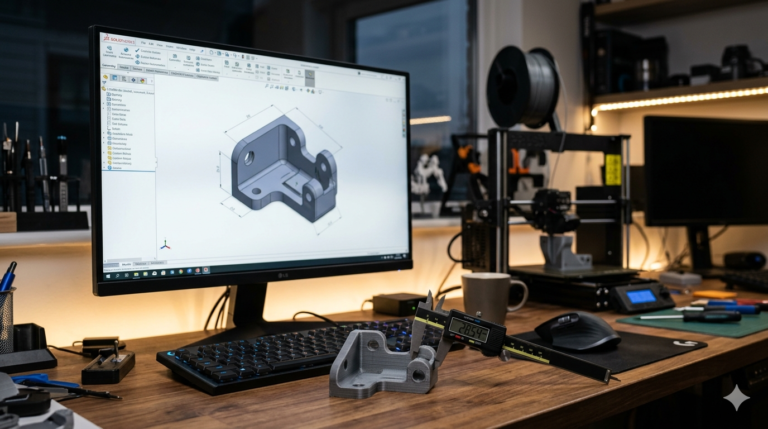
A 3d printed case is the most common first custom design project for makers, product developers, and electronics engineers — and also one of the most frequently botched. The geometry looks deceptively simple on screen (it is just a box with a lid, right?), but a case that fits precisely, protects reliably, assembles cleanly, and looks professional requires careful engineering of wall thickness, mating tolerances, snap-fit mechanics, ventilation strategy, and connector cutout positioning that separates a prototype-quality enclosure from a production-quality product housing. This guide covers the complete design, printing, and finishing workflow for custom 3D printed cases based on thousands of enclosure projects our studio has delivered across consumer electronics, IoT devices, industrial controllers, and hobbyist projects.
When a 3D Printed Case Is the Right Manufacturing Choice
A custom 3d printed case makes economic sense for production volumes under 500 units, prototyping at any volume, and applications where geometric customization per unit or per batch is required. Above 500 identical units, injection molding typically becomes cheaper per piece — but the $5,000 to $30,000 mold tooling investment means the break-even point is real only when the design is finalized and production volume is committed. For products still iterating on their geometry, user testing their form factor, or serving niche markets with 50 to 200 unit annual demand, 3D printing eliminates the tooling investment entirely and allows geometry changes between production batches at zero incremental cost.
The material options for printed cases cover most functional requirements. PLA for indoor, non-heat-exposed applications where cosmetic surface quality is the priority. PETG for functional enclosures requiring moderate heat resistance (up to 75 degrees Celsius), chemical resistance, and impact durability. ABS for high-temperature environments (up to 95 degrees Celsius) and applications requiring acetone vapor smoothing for injection-mold-quality surface finish. Nylon (SLS or FDM) for industrial applications demanding superior mechanical strength, fatigue resistance, and chemical compatibility. The Simplify3D material guide provides detailed property comparisons across all common printing materials organized by application category.
Wall Thickness and Structural Integrity for Printed Cases
For FDM-printed cases with a 0.4 mm nozzle, the minimum recommended wall thickness is 1.6 mm (four perimeters) rather than the 1.2 mm (three perimeters) minimum sufficient for non-enclosure parts. Cases experience handling loads — being picked up, set down on hard surfaces, stacked, dropped from desk height — that impose impact forces exceeding what most printed parts encounter. The fourth perimeter adds roughly 15 percent more material cost and print time but doubles the drop-test survival height from approximately 0.5 meters to 1.0 meter for a typical 100 mm by 60 mm PETG enclosure containing a 50-gram PCB assembly.
For cases protecting sensitive electronics (display modules, precision sensors, optical components), increase wall thickness to 2.0 mm and add internal ribs at strategic locations — typically 2 to 3 ribs running perpendicular to the longest axis of the case, 1.5 mm wide and 3 mm tall, positioned to create three or four separated internal bays that prevent the PCB from sliding during impact and distribute crush forces across multiple structural paths rather than concentrating them at the mounting point corners. SLA-printed cases can use thinner walls (1.0 to 1.2 mm) because resin parts are isotropic — equally strong in all directions — unlike FDM parts where inter-layer adhesion creates a weak axis.
Snap-Fit Joint Design for 3D Printed Case Closures
Snap-fit cantilever hooks are the preferred closure method for custom 3d printed case designs because they eliminate separate fasteners, reduce assembly time to a single push-click motion, and lower the bill of materials cost by removing screws, nuts, and threaded inserts. The design parameters are beam length (longer beams deflect with lower stress, reducing fatigue failure risk), beam thickness (determines engagement force and retention force independently), deflection distance (must exceed the hook retention depth plus the mating clearance), and ramp angle (typically 45 degrees for assembly, 90 degrees for retention to prevent accidental disengagement).
For FDM-printed ABS, limit cantilever strain to 2 percent maximum at full deflection. For PETG, limit to 1.5 percent. For PLA, limit to 1.0 percent because PLA is brittle under sustained bending loads and will crack at the beam root after 50 to 200 open-close cycles if strain exceeds this threshold. Print the snap-fit beam perpendicular to the layer lines whenever possible — a beam printed with layers parallel to its length will delaminate at the weakest layer bond long before reaching the material’s bulk strain capacity. When orientation constraints prevent perpendicular printing, reinforce the beam root with a generous fillet (minimum 2 mm radius) and increase beam thickness by 30 percent to compensate for the reduced inter-layer shear strength.
For cases requiring frequent opening (battery compartments, SD card access, user-serviceable components), M2.5 or M3 brass heat-set inserts pressed into the plastic with a soldering iron provide reusable threaded connections that survive thousands of open-close cycles without degradation. Model the insert receiving hole 0.2 mm smaller than the insert outer diameter for a reliable press-fit that holds under vibration. The insert installs in 10 seconds per location with a temperature-controlled soldering iron set to 220 degrees Celsius for ABS, 200 degrees for PETG, and 180 degrees for PLA.

Ventilation and Thermal Management for Electronics Cases
Electronics generate heat. A sealed 3d printed enclosure box with no airflow will overheat any microcontroller, power supply, or LED driver running at moderate to full load. The basic thermal management strategy for printed cases is passive ventilation — intake openings low on the case body and exhaust openings high on the case lid, positioned to create a natural convection chimney where warm air rises out the top while cool ambient air enters from below. For a typical Raspberry Pi or Arduino-based project, ventilation slots totaling 15 percent of two opposing face areas (one intake face, one exhaust face) maintain junction temperatures within safe operating limits at sustained full CPU load.
Ventilation slot geometry matters for both airflow and structural integrity. Slots should be 1.5 mm to 2.0 mm wide for FDM printability (narrower slots close during printing) and arranged in a grid or honeycomb pattern that maintains wall stiffness between openings. A popular approach for protective 3d print case designs is a hexagonal honeycomb pattern with 2 mm wall between hexagons — this pattern provides excellent open area for airflow while maintaining the highest structural stiffness-to-weight ratio of any ventilation geometry. The pattern also prints cleanly on FDM without support material when oriented with hex columns aligned vertically.
For outdoor or dusty environments where ventilation openings allow particle ingress, a labyrinth baffle geometry forces incoming air through a 90-degree turn that traps larger particles by inertia while permitting airflow. This approach provides IP4X-equivalent dust protection without filters that clog and require maintenance. The trade-off is 30 to 40 percent reduced airflow compared to direct openings — acceptable for low-power electronics but insufficient for high-heat-density applications where active fan cooling becomes necessary regardless of case geometry.

Precision Connector Cutouts and Cable Management
USB-C ports, barrel jacks, HDMI connectors, SMA antenna connectors, and LED indicators all require precisely positioned cutouts in the case wall. The critical reference dimension is the connector’s panel-mount flange position relative to the PCB mounting hole pattern — not the cable diameter or connector body dimension. In SolidWorks, we model cutouts as parametric references linked to the PCB assembly sketch, so moving the PCB by 1 mm automatically shifts all connector cutouts by the same amount without manual adjustment of each individual feature.
Add 0.3 mm clearance on each side of every connector cutout for FDM tolerance variation (0.15 mm for SLA). This clearance prevents the connector from binding during assembly while keeping the gap small enough to look clean and prevent significant light leakage from internal LEDs. For connectors that need strain relief (power cables, sensor wires, antenna cables), model a printed cable gland with a compressible passage that grips the cable jacket — a 2 mm diameter circular opening for a 3 mm cable provides sufficient clamping force for basic strain relief without requiring separate hardware like cable glands or grommets.
Mating Tolerances for Lid-to-Base Case Assemblies
The most common failure point in 3d printed case design is the lid-to-base mating interface. Too tight, and the halves bind during assembly, requiring force that stresses snap-fits and warps thin walls. Too loose, and the case rattles, light leaks through the seam, and dust enters the enclosure. For FDM-printed cases, add 0.3 mm clearance per side on mating surfaces — this produces a snug fit that slides together smoothly without binding on well-calibrated printers. For SLA, tighten to 0.15 mm per side.
Lip-and-groove (tongue-and-groove) joints add alignment precision and dust resistance to the mating interface. Model the groove 0.4 mm wider than the lip for FDM (0.2 mm for SLA). The lip should be 1.0 to 1.5 mm tall and 1.0 mm wide for typical consumer-scale enclosures — tall enough to engage positively during assembly and block dust ingress, but not so tall that the engagement force becomes uncomfortable for hand assembly. Always prototype the mating interface with a small test coupon before printing the full case — two 30 mm by 30 mm squares with the lip-and-groove profile print in 15 minutes and verify the fit tolerance at a fraction of the cost and time of reprinting the complete enclosure when the tolerance is wrong.

Surface Finishing Techniques for Professional-Looking Cases
FDM-printed cases show visible layer lines at the configured layer height — 0.2 mm layers produce a textured surface that is functional but not cosmetically competitive with injection-molded products. Four post-processing techniques improve surface quality progressively. Sanding (120, 240, 400, 800 grit progression) removes layer lines but is labor-intensive on curved surfaces and internal features. Filler primer spray (automotive filler primer, 2 to 3 coats with light sanding between) fills remaining layer artifacts and creates a paintable surface suitable for cosmetic prototypes and low-volume production. Acetone vapor smoothing (ABS only) dissolves the outer surface layer uniformly, producing a glossy, smooth finish that rivals injection molding — but rounds sharp edges and can obscure fine geometric details if exposure time is not carefully controlled.
For cases destined for professional presentation or retail sale, the finishing workflow is: print at 0.12 mm layer height for minimum initial layer visibility, sand with 240 and 400 grit, apply two coats of filler primer with 400-grit wet sanding between coats, then finish with spray paint in the target production color (matching a Pantone or RAL reference). Total finishing time: 3 to 4 hours per case including drying intervals. Total finishing material cost: $5 to $15 per case. The result is visually indistinguishable from injection-molded production parts in photographs and across a conference table at normal viewing distance — sufficient for investor demonstrations, trade show displays, and early customer samples where cosmetic quality signals product readiness.
PCB Mounting and Internal Component Securing
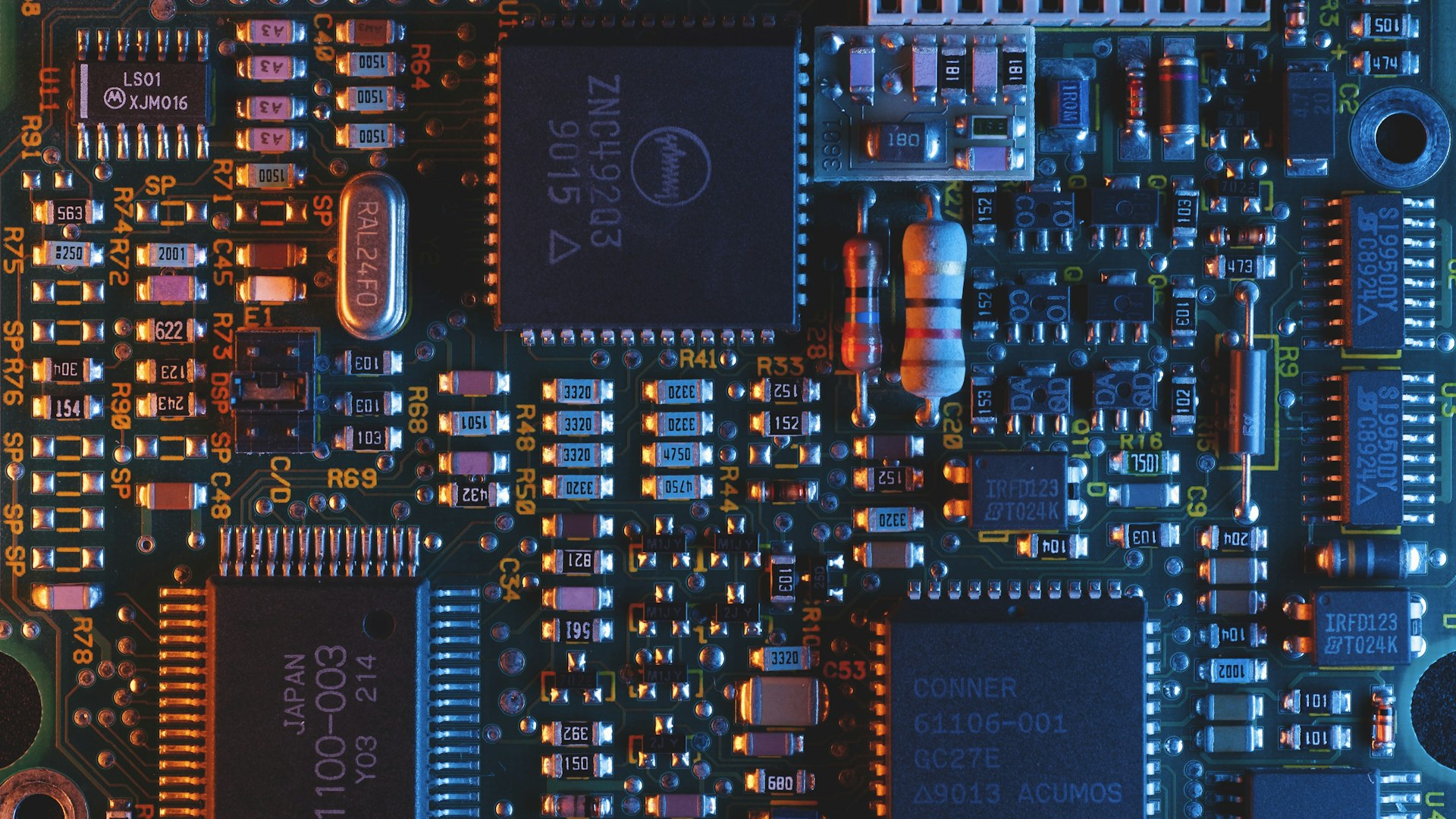
Printed standoffs with M2.5 or M3 screw bosses are the standard method for mounting PCBs inside 3d printed case designs. The boss outer diameter should be at least 2.5 times the screw diameter for adequate wall strength — 6.5 mm OD for M2.5 screws, 7.5 mm OD for M3 screws. Boss height equals the desired PCB clearance from the case floor plus the board thickness — typically 4 to 6 mm clearance for standard-height through-hole components plus 1.6 mm PCB thickness. For press-fit mounting without screws, reduce the boss inner bore by 0.15 mm below the screw major diameter and use self-tapping plastic screws that cut their own threads during insertion — this approach eliminates loose hardware but limits the reassembly count to approximately 10 cycles before the threads strip.
Components taller than the case interior height — display modules, tall electrolytic capacitors, heatsinks, and antenna modules — need dedicated clearance pockets modeled into the case lid. Map every component height from the PCB datasheet or physical measurement and add 1 mm clearance above the tallest component to prevent lid contact that stresses solder joints during assembly. We model the case and PCB together in a SolidWorks assembly, running interference detection after every lid modification to confirm zero contact between printed plastic and electronic components throughout the full assembly tolerance range.
Labeling, Branding, and Cosmetic Features on Printed Cases
Embossed text (raised from the surface) and engraved text (recessed into the surface) are both achievable on FDM-printed cases with specific design rules. Minimum text height: 1.5 mm for readability at arm’s length. Minimum stroke width: 0.6 mm (at least 1.5 times the nozzle diameter). Embossed text depth: 0.4 to 0.8 mm for clean definition without excessive print time. Engraved text depth: 0.4 to 0.6 mm for legible deboss that does not compromise wall structural integrity. For product branding on custom 3d printed case designs, embossed logos read better than engraved on light-colored materials because the raised edges catch side light, while engraved logos work better on dark materials where the depth shadow creates contrast against the surrounding surface.
Batch Production of 3D Printed Cases
For production runs of 50 to 500 units, FDM print farms with 5 to 20 machines operating in parallel produce consistent output at predictable per-unit costs. Parts per day depends on case size and print settings — a typical 100 mm by 60 mm by 30 mm case prints in 4 to 6 hours at 0.2 mm layer height with 30 percent infill, yielding 4 to 6 parts per printer per 24-hour production day. A 10-printer farm produces 40 to 60 cases per day, completing a 200-unit production run in 3 to 5 days. Per-unit material cost for PETG at this size is $2 to $5, with total per-unit cost including machine amortization, electricity, operator labor, and quality inspection ranging from $8 to $20 depending on complexity and finishing requirements.
For cases requiring smoother surfaces than FDM provides at production volumes below the injection molding break-even point, Multi Jet Fusion (MJF) printing in nylon PA12 produces parts with fine, uniform surface texture, dimensional accuracy of plus or minus 0.2 mm, and mechanical properties suitable for production-grade enclosures. MJF pricing through service bureaus runs $15 to $50 per case depending on size, with lead times of 3 to 5 business days and no minimum order quantities. The Xometry manufacturing resources provides instant MJF quoting with DFM feedback for uploaded case geometry.

Explore real examples of this work in our portfolio — see our custom brackets and mounts in SolidWorks and custom PCB enclosure project box projects. Need professional engineering support? Our prototype design service and SolidWorks modeling service deliver production-ready files in 24 hours.
Get Your Custom Case Designed in 24 Hours
Whether you need a protective housing for a Raspberry Pi project, a custom enclosure for an industrial sensor array, a retail-ready product case for an Amazon FBA launch, or a one-off protective carrier for specialized equipment, professional 3d printed case design delivers geometry engineered for your specific PCB dimensions, connector positions, thermal requirements, and cosmetic expectations. With 7,000+ projects delivered across 40+ countries, a 4.9-star rating from 4,470+ verified reviews, and 24-hour turnaround on most single-part enclosure designs, our team at minicad.io delivers print-ready case files that fit precisely, protect reliably, and look genuinely professional from the very first print attempt. Get a free quote and have your custom, precision-engineered case designed by tomorrow.