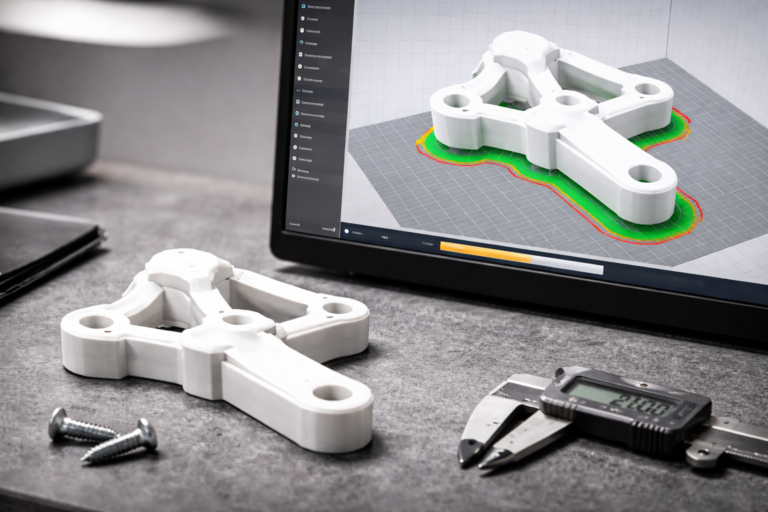
Following proven 3d print design guidelines before exporting your first STL eliminates the most common and most frustrating category of print failures — parts that look perfect in CAD but warp, crack, sag, or simply refuse to print cleanly on the physical machine. These guidelines are not theoretical suggestions. They are engineering constraints derived from the physics of additive manufacturing, validated across thousands of prints on dozens of printer models in our studio, and applicable to every FDM, SLA, and SLS project regardless of part geometry, material selection, or printer brand.
FDM 3D Print Design Guidelines — The Critical Numbers
Minimum wall thickness: 1.2 mm for standard parts, 1.6 to 2.0 mm for structural or impact-resistant parts. Maximum unsupported overhang angle: 45 degrees from vertical (material-dependent — PLA tolerates 60 degrees on short spans with good cooling). Maximum bridge span: 50 mm for PLA, 35 mm for PETG, 20 mm for ABS. Minimum hole diameter: 2.0 mm vertical, 3.0 mm horizontal (add 0.4 mm compensation to all holes for nozzle path contraction). Mating surface clearance: 0.3 mm per side. Press-fit insert hole undersizing: 0.2 mm below insert OD. Minimum embossed text: 1.5 mm height, 0.6 mm stroke width. These numbers represent the reliable operating envelope for 0.4 mm nozzle FDM printers at 0.2 mm layer height — the most common configuration worldwide.
These design thresholds change when your printer configuration changes. A 0.6 mm nozzle increases minimum wall to 1.8 mm and minimum feature width to 1.2 mm but enables 40 percent faster print times for large parts. A 0.25 mm nozzle reduces minimum feature size to 0.5 mm but doubles print time and is prone to clogging with filled or composite filaments. Always specify your nozzle diameter and layer height when requesting professional CAD design so the designer can calibrate every dimension to your actual hardware capability. The PrusaSlicer documentation supports all common nozzle diameters and automatically adjusts toolpath generation to match.

SLA and SLS Design Guidelines
SLA resin printing resolves finer geometry: 0.5 mm minimum walls, 0.3 mm minimum features, 0.5 mm minimum text. But SLA introduces unique constraints absent from FDM — suction forces during peel steps (avoid large flat downward-facing surfaces exceeding 25 square centimeters without drainage holes or orientation changes), mandatory drain holes for hollow geometry (minimum 3 mm diameter, positioned at the lowest point during printing), and post-processing dimensional change during UV final cure (0.1 to 0.2 percent linear shrinkage depending on resin formulation).
SLS nylon requires 0.7 mm minimum walls, 1.0 mm minimum features, and generous clearances (0.5 mm per side) for mating surfaces due to lower dimensional accuracy compared to FDM and SLA. The advantage is zero support requirements — the powder bed provides complete self-support during sintering, enabling geometries impossible on any other accessible process: interlocking chains, internal lattices, and living hinges printed as single assembled units. The Simplify3D material guide provides material-specific property and design data for every common printing material across all three processes.

Print Orientation Guidelines That Prevent Failures
Orient the part so the primary load direction aligns with the XY (strong) axis, not the Z (weak layer-bond) axis. Place the largest flat surface on the build plate for maximum adhesion and dimensional stability. Position cosmetic surfaces as either horizontal top faces (smooth) or vertical walls (consistent texture) — never as bottom faces where support contact marks and bed texture transfer create rough, marked surfaces that require post-processing to remediate.
For parts with multiple competing orientation requirements (strength needs vertical printing but cosmetics need horizontal printing), our studio evaluates the trade-offs quantitatively and recommends the orientation that maximizes the most critical performance metric with documented rationale explaining what the orientation sacrifices in secondary metrics. These orientation notes, included with every STL delivery, transform a bare geometry file into a complete print specification that any operator can execute confidently.

Material-Specific 3D Print Design Guidelines
Each filament material modifies the general 3d print design guidelines with specific requirements. ABS requires an enclosed heated chamber (minimum 40 degrees Celsius ambient) and must avoid large flat surfaces exceeding 100 by 100 mm that warp aggressively during cooling — add corner mouse-ear tabs or use brim adhesion in the slicer. PETG strings between travel moves — design geometry that clusters features and minimizes open travel distances, and set retraction to 5 to 7 mm at 40 mm per second minimum. PLA is the most forgiving material but softens at 55 degrees Celsius — never use PLA for parts near heat sources, in vehicles, or in direct sustained sunlight.
TPU (flexible filament) cannot bridge at all — every horizontal span requires support regardless of distance. Minimum wall thickness for TPU is 2.0 mm because thin flexible walls deform unpredictably under the nozzle pressure of subsequent layers. Nylon absorbs atmospheric moisture within hours of exposure, changing dimensions by 0.5 to 1.5 percent — design nylon parts with clearances that accommodate this hygroscopic dimensional change, or specify sealed storage with desiccant in the delivery notes. These material-specific overrides take priority over the general process rules whenever a conflict exists between general and material-specific recommendations.
Tolerance and Clearance Guidelines for Assemblies
FDM dimensional accuracy: plus or minus 0.2 mm for features under 100 mm, degrading with part size. Mating clearance: 0.3 mm per side. Lip-and-groove joints: groove width equals lip width plus 0.4 mm for FDM. Snap-fit maximum strain: 2 percent for ABS, 1.5 percent for PETG, 1.0 percent for PLA. Screw boss OD: minimum 2.5 times screw diameter. Thread engagement depth for self-tapping screws: minimum 2 times screw diameter in solid printed walls. These assembly tolerance values produce reliable first-time fits when applied consistently — eliminating the trial-and-error reprinting that occurs when designers guess at clearances without empirical reference data.
Explore real examples of this work in our portfolio — see our custom PCB enclosure project box and multi-color 3D printed NFC coin projects. Need professional engineering support? Our outsource CAD design service and technical drawing service deliver production-ready files in 24 hours.
Get Files That Follow Every Guideline Automatically
Every project at minicad.io applies all documented 3d print design guidelines automatically — calibrated to your specific printer, material, and nozzle configuration. With 7,000+ projects delivered, a 4.9-star rating, and 24-hour turnaround, get a free quote and receive files that print correctly because every guideline is embedded in the geometry from the first SolidWorks sketch.